Blog
Liquidation Pallets: $600–$1,500 Real Landed Cost for Resellers

Expect an all-in cost of roughly $600 to $1,500 for a typical liquidation pallet once freight, shrinkage, and prep are factored in, with electronics and specialty categories landing at the higher end and books or apparel often coming in cheaper. That “all-in” figure covers the sticker price plus freight and handling losses, not just what you pay at checkout. Anyone quoting a $29 pallet is selling salvage-grade goods, not the real thing.
TL;DR:
- Most liquidation pallets cost between $600 and $1,500, with electronics and specialty items at the higher end and books or apparel typically cheaper.
- Pallet prices vary based on manifest clarity, condition grade, source retailer, timing, and auction versus fixed-price formats, impacting resale potential.
- The actual profit depends on the landed cost per unit, which includes pallet price, freight, handling, shrinkage, and platform fees, divided by the estimated sellable units.
- Starting buyers should test with a single pallet, verify manifests, conditions, and shipping details before scaling to larger orders or truckloads.
- Buyer protections hinge on paying with secure methods, understanding manifest disclosures, confirming seller legitimacy, and reviewing return and dispute policies.
Table of Contents
- How Much Is a Liquidation Pallet Across Different Price Bands?
- What Actually Changes the Price You Pay?
- How Do You Calculate the Real Landed Cost per Unit?
- Which Buying Format Fits Your Budget and Experience?
- Test One Pallet Before You Scale: A Buyer’s Checklist
- What Legal Protections Should Buyers Know Before Purchasing?
- Do Liquidation Pallet Prices Vary by Region or Season?
- When a Pallet Is a Smart Buy, and When to Walk Away
- Ready to Buy Your First Test Pallet?
- Sources
How Much Is a Liquidation Pallet Across Different Price Bands?
Pallet pricing splits into four rough bands, and knowing which one you’re looking at prevents a lot of buyer’s remorse.
Entry or test pallets run from a couple of hundred dollars up to around $1,000, according to the beginner buying checklist from Wholesale Pallet Liquidators. These usually carry 40 to 80 mixed units and work as a low-risk way to test a new category or supplier.
Standard pallets land in the $600 to $1,500 range, holding anywhere from 60-plus to 80 units depending on weight and category, per CLOSO’s direct liquidation pallet guide. This is where most resellers spend their working budget.
Specialty or high-value pallets (think electronics, tools, or name-brand apparel) push toward the top of that range or beyond, since manifests list higher retail value per unit even when unit counts are lower.
Truckloads bundle roughly 24 pallets and amortize freight across the whole load, per the same CLOSO data, cutting your per-unit shipping cost but demanding real upfront capital and warehouse space.
- Entry/test pallet: a few hundred dollars, 40 to 80 units
- Standard pallet: $600 to $1,500, 60-plus to 80 units
- Specialty pallet: similar or higher sticker price, fewer but pricier units
- Truckload: 24 pallets, lowest per-unit freight, highest total commitment
Category drives these numbers as much as format does. A books pallet sells for less because per-unit resale value is low. An electronics pallet costs more because a single water-damaged laptop can wreck your margin if the manifest isn’t accurate.
What Actually Changes the Price You Pay?
Two pallets with the same sticker price can deliver wildly different returns, and the difference almost always comes down to four factors.
Manifested vs. unmanifested is the biggest one. A manifested pallet lists each item, its retail value, and often its condition, which lets you estimate resale value before you buy. Unmanifested pallets are cheaper but blind, and that discount exists because you’re absorbing the guesswork.
Condition grade matters just as much. Customer returns typically sell well since items are often functional. Shelf-pull inventory (unsold retail stock) usually commands a premium because it’s untouched by consumers. Salvage grade sits at the bottom, priced low because a meaningful share of units may be damaged or unsellable.
Source retailer and timing shift availability. Post-holiday windows in January flood the market with electronics and toy returns, often softening prices temporarily. Overstock from a single big-box retailer tends to price higher than mixed-source lots because buyers trust the manifest more.
Auction vs. fixed-price formats change your expected cost too. Auction platforms show real price volatility, and using a platform’s sales-history tool before bidding helps you avoid overpaying in a bidding war, per Direct Liquidation’s marketplace data.
- Manifested pallets cost more but reduce guesswork
- Shelf-pull grade generally outsells salvage grade
- Post-holiday season often means more supply, softer prices
- Auction formats require price-history research before bidding
Pro Tip: Never bid on an auction pallet without checking at least three recent closed sales in that category. A single outlier sale can make a fair price look like a steal, or a steal look like a trap.
How Do You Calculate the Real Landed Cost per Unit?
Sticker price tells you almost nothing until you convert it to landed cost per unit, which is the number that actually determines whether a pallet is profitable.
The formula is straightforward:
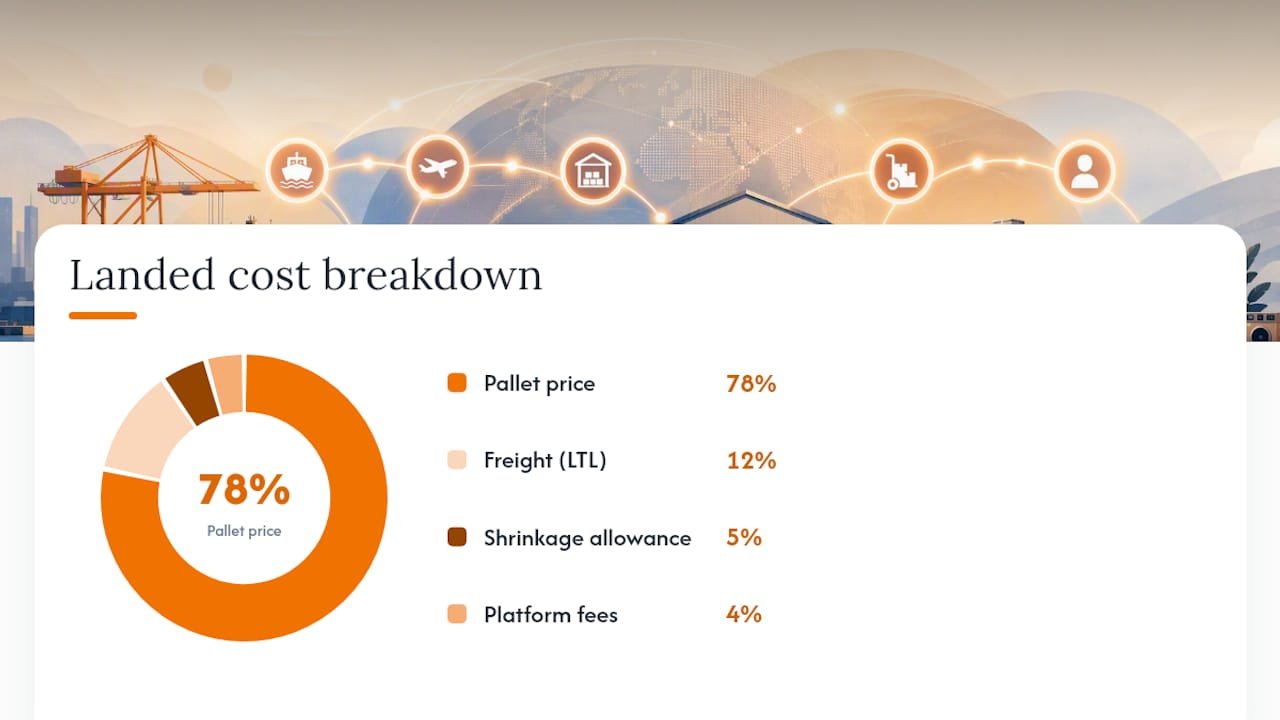
- Add pallet price, freight, prep/sorting labor, and a shrinkage allowance for damaged or unsellable items.
- Add any resale platform fees you’ll pay when the goods sell.
- Divide that total by your estimated number of sellable units, not the manifest’s total unit count.
Freight is where most new buyers get surprised. LTL freight on a single pallet commonly runs $90 to $180, according to CLOSO’s pallet liquidation store pricing data, which can add 10 to 20 percent to your total cost before you’ve sorted a single box.
A quick example: A $900 pallet with $140 freight, a $60 shrinkage allowance, and $50 in platform fees totals $1,150. If you estimate 90 sellable units out of 100 listed, your landed cost is roughly $12.78 per unit. If your average resale price is $22, you’re clearing about $9 per unit before your own time. That gap between headline price and per-unit cost is the real profitability gatekeeper, not the number on the listing.
Which Buying Format Fits Your Budget and Experience?
Format changes your risk exposure as much as it changes your price per pallet.
- Single pallet: highest per-unit freight cost, lowest capital requirement, best for testing a new category or supplier before committing further.
- Case lot: smaller than a pallet, useful for very tight budgets or niche products, but freight efficiency is poor.
- Auction pallets: can deliver below-market pricing, but require research discipline and a tolerance for price swings.
- Truckloads: the cheapest per-unit cost thanks to amortized freight, but they demand real storage space and tie up thousands of dollars at once.
A first-time buyer should start with a single pallet. A reseller scaling an established channel can move to case lots or small truckload commitments. A high-volume buyer with warehouse space and steady sell-through is the only one who should be buying full truckloads regularly, since slow-turnover truckload inventory ties up cash fast.
Test One Pallet Before You Scale: A Buyer’s Checklist
Before committing real money to a supplier, run a single pallet through this checklist:
- Request the manifest and sample photos before paying, not after.
- Verify the stated condition grade against the photos and item descriptions.
- Confirm the shipping method, estimated freight cost, and return policy in writing.
- Budget separately for freight and sorting labor rather than folding them into “misc” costs.
- Track sell-through rate, manifest accuracy, and percent unsellable once the pallet arrives.
Starting with one test pallet is the lowest-risk way to validate a new supplier or category before scaling into case lots or truckloads. If your sell-through lands above 70 percent and the manifest matched reality, that supplier earns your next order.
Liquidation suppliers often organize inventory by category, offer nationwide shipping, and provide secure payment processing so resellers can evaluate a supplier without guessing at freight or condition grading upfront.
Buyers can review supplier background on the Mega Pallets Liquidation about page, and browse ready categories including mixed electronic pallets for a higher-value test run.
What Legal Protections Should Buyers Know Before Purchasing?
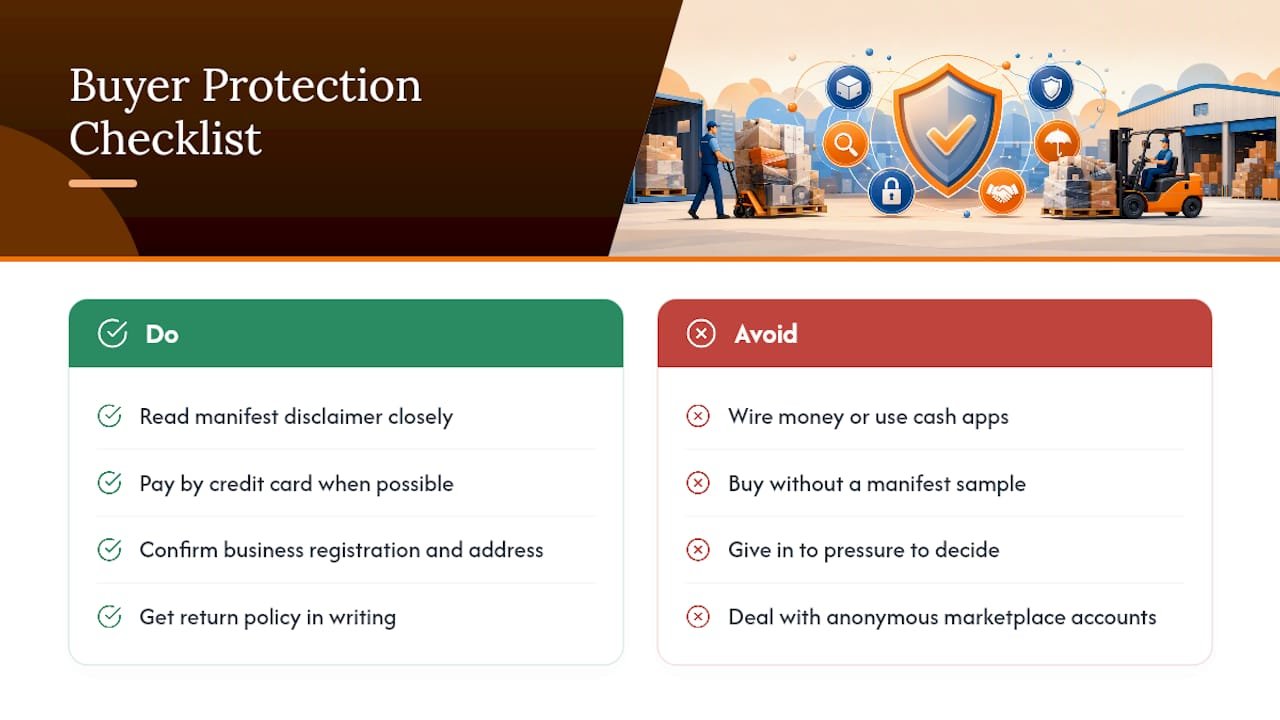
Liquidation pallets are legal merchandise, but the protections you get depend entirely on how you buy. Most reputable sellers operate under standard commercial sale terms, meaning the pallet is sold “as described” against its manifest, not “as advertised” against a marketing photo. Read the manifest disclaimer language closely. Some sellers explicitly state that manifest accuracy isn’t guaranteed, which shifts risk onto you.
Payment method matters for buyer protection. Paying by credit card typically gives you a dispute path if a seller misrepresents condition or simply never ships. Wire transfers and cash apps offer none of that safety net, and scam listings disproportionately push buyers toward those payment types.
Always confirm a seller’s business registration and physical shipping address before wiring any large sum. Legitimate liquidation sellers are typically registered businesses with traceable shipping records, not anonymous marketplace accounts. If a seller refuses to provide a manifest sample, refuses standard payment methods, or pressures you to decide within minutes, treat that as a red flag rather than urgency.
Return policies vary widely by seller and should be confirmed in writing before purchase, since liquidation sales are frequently final-sale once a pallet ships.
Do Liquidation Pallet Prices Vary by Region or Season?
Regional pricing differences exist mainly because of freight distance from major distribution hubs, not because the merchandise itself costs more or less in different states. A buyer near a large distribution center in the Midwest or Southeast often pays less freight than someone on the West Coast ordering from an East Coast liquidator, simply because LTL shipping charges scale with distance and fuel costs.
Seasonal timing moves prices more than geography does. Post-holiday months, especially January and February, typically bring a surge in customer-return inventory from electronics and toys, which can soften prices temporarily as supply outpaces demand. Back-to-school season shifts supply toward apparel and school goods. Retailers also run larger closeout waves at fiscal year-end, which varies by company but often clusters in late summer or early winter.
Market-wide, e-commerce return volume has grown steadily as more retail shifts online, which keeps the overall liquidation supply chain fairly steady year over year even as individual category prices fluctuate. Buyers who track seasonal patterns in their preferred category, rather than buying reactively, tend to catch better pricing windows than buyers who purchase on a fixed schedule regardless of season.
When a Pallet Is a Smart Buy, and When to Walk Away
Liquidation pallets reward resellers who already have a sales channel, working capital beyond the purchase price, and patience to sort inventory before flipping it. If you’re starting from zero capital or have no place to sell, skip pallets for now. The buyers who lose money aren’t the ones who picked a bad pallet. They’re the ones who bought a truckload before confirming they could move a single test pallet first.
— Nene
Ready to Buy Your First Test Pallet?
Most liquidation sellers make you choose between vague listings with no manifest or bulk truckload minimums that lock up a significant amount of capital before you’ve proven a category works. Some sellers give resellers organized, category-specific pallets with manifest detail up front, so you can test a category at pallet scale instead of committing to a truckload blind.
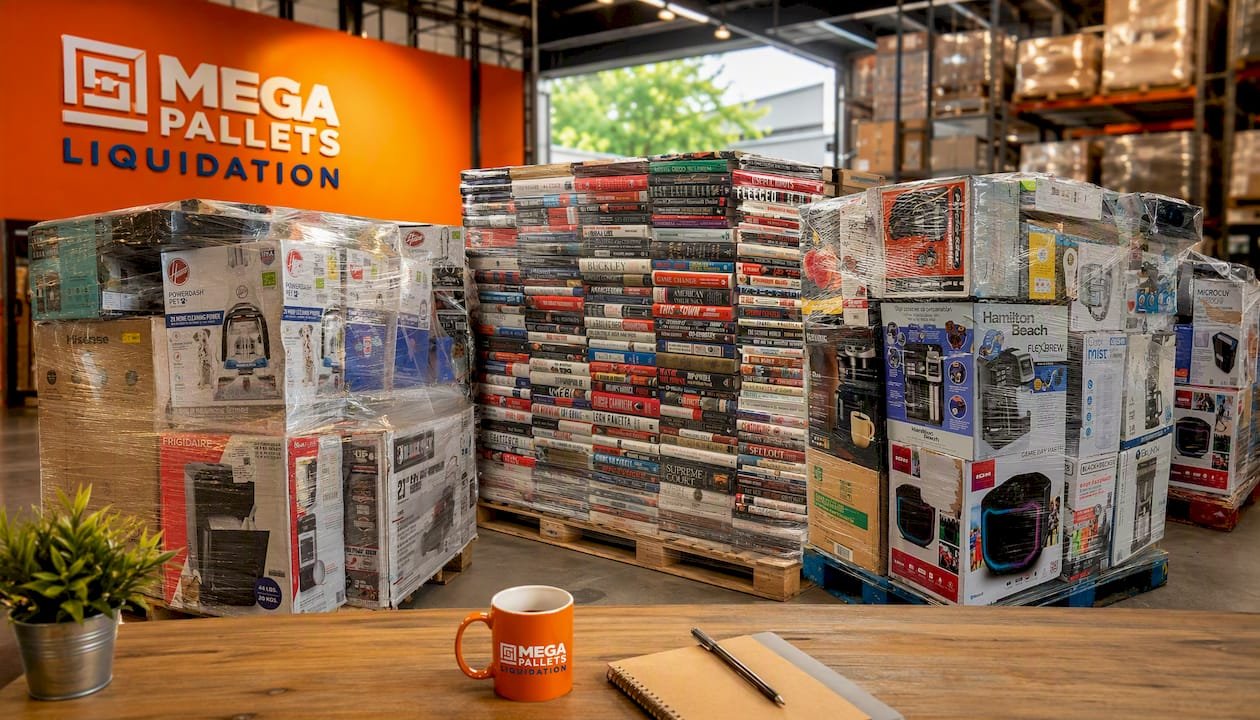
If you’re testing your first order, start with the Amazon bulk liquidation pallets for broad category variety, or the mixed books liquidation pallets for a lower-risk, lower-cost entry point. Buyers targeting higher resale margins can review the mixed electronic pallets page, where manifest detail matters most. Before you order, check the how to order page to understand shipping timelines and freight expectations, then browse the full liquidation pallet catalog to compare categories side by side and pick your first test pallet today.
Sources
For deeper cost breakdowns, review CLOSO’s direct liquidation pallet guide for landed-cost math, the pallet liquidation store checklist for verifying sellers, and the beginner’s buying checklist for a first-purchase walkthrough. For red-flag detection, see how to buy liquidation pallets without getting burned.
Recommended
- Shop Liquidation Pallets | 100+ Unbeatable Wholesale Pallet Deals | Liquidation Pallets For Sale
- Wholesale Mixed Books Liquidation Pallets (900–1,000 Books per Pallet) Mixed Books Liquidation Pallets For Sale
- Grocery Pallets Wholesale Mixed : Unbeatable Bulk Food & Household Essentials
- Wholesale PlayStation 5 Console Liquidation Pallet – 12 High-Demand PS5 Consoles | PlayStation 5 Console For Sale