Uncategorized

Milwaukee tool liquidation pallets wholesale amazon

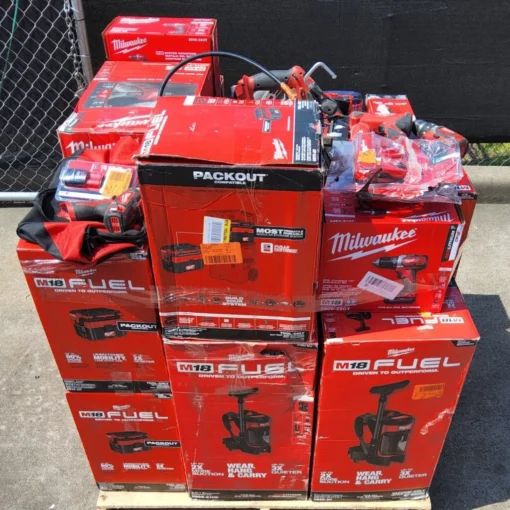
Milwaukee Sawzall Liquidation Pallet — 80 New M18 Fuel Tools

Table of Contents

Milwaukee tool liquidation pallets wholesale amazon
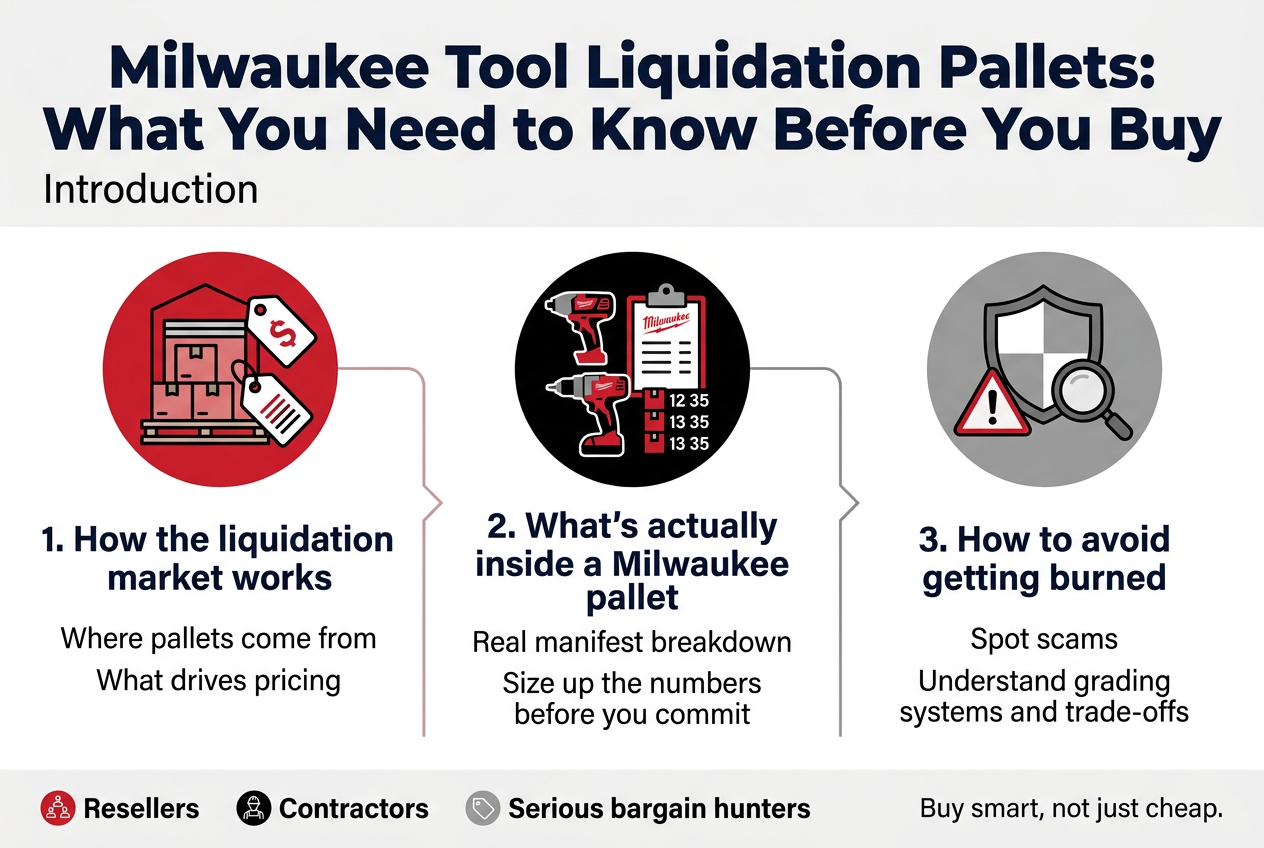
Create a clean, professional infographic illustration in a 3:2 aspect ratio with a full-bleed layout, no frame, no narrow vertical stack, and wide horizontal sections. Use a modern sans-serif font, bold navy headings, dark charcoal body text, and accent colors in Milwaukee-style red, black, gray, and white. Top header across the full width: Large bold title text: "Milwaukee Tool Liquidation Pallets: What You Need to Know Before You Buy" Smaller subtitle below: "Introduction" Below the header, use a wide 3-column layout with three large content blocks, each with a clear numbered label and a matching icon. Left block: A red circular icon with a warehouse pallet, boxes, and a price tag. Heading text: "1. How the liquidation market works" Short body text in two lines: "Where pallets come from" "What drives pricing" Center block: A black circular icon with Milwaukee-style power tools, a clipboard manifest, and stacked item counts. Heading text: "2. What's actually inside a Milwaukee pallet" Short body text in two lines: "Real manifest breakdown" "Size up the numbers before you commit" Right block: A gray circular icon with a shield, warning sign, and a magnifying glass. Heading text: "3. How to avoid getting burned" Short body text in two lines: "Spot scams" "Understand grading systems and trade-offs" Along the bottom, add a wide horizontal strip with a brief audience callout using small icon markers for each group: "Resellers" "Contractors" "Serious bargain hunters" Add a final small closing line at the bottom right: "Buy smart, not just cheap." Use subtle arrows or connecting lines between the three blocks to show progression from market basics to pallet contents to risk avoidance. Keep spacing balanced, edges clean, and hierarchy strong with the title dominant at the top and the three sections clearly separated.

Milwaukee Tool Liquidation Pallets: What You Need to Know Before You Buy

If you’ve been searching for Milwaukee tool liquidation pallets wholesale, you already know the appeal — premium tools at a fraction of retail price. But the market moves fast, the risks are real, and not every deal is what it looks like on the surface.

This guide is for resellers, contractors, and serious bargain hunters who want to buy smart, not just cheap. Whether you’re building an eBay store, stocking a job site crew, or sourcing inventory for a flea market booth, the same rules apply: know what you’re buying, who you’re buying from, and what the numbers actually look like after fees and freight.

Here’s what we’ll cover:

  • How the liquidation market works — where these pallets come from and what drives the pricing

  • What’s actually inside a Milwaukee pallet — a real manifest breakdown so you can size up the numbers before you commit

  • How to avoid getting burned — spotting scams, understanding grading systems, and knowing the trade-offs before you spend a dollar

Let’s get into it.

What Are Milwaukee Tool Liquidation Pallets and How Does the Market Work
Create a clean, modern infographic illustration in full-bleed landscape format, aspect ratio 3:2, with a white background, Milwaukee red accents, dark charcoal text, and subtle gray divider lines. Use a bold sans-serif headline at the top spanning the width: "What Are Milwaukee Tool Liquidation Pallets and How Does the Market Work". Layout: wide horizontal infographic with 4 main sections arranged in a clear 2-row grid, each section in a rounded rectangular block with a small icon and numbered label. Use strong visual hierarchy, bold subheadings, short body text, and a professional business style. Top header area: - Large bold title centered near the top - Thin red underline beneath the title - Small subtitle line under the title: "Wholesale supply chain • Secondary market • Reseller demand" Section 1 on the upper left: - Numbered label "1" - Icon: stacked cardboard pallets with tools - Subheading: "What Milwaukee tool liquidation pallets are" - Body text: "Bulk lots of Milwaukee tools sold below retail through wholesale liquidation channels." - Smaller line below: "Tools are packed onto pallets for resellers and deal hunters." Section 2 on the upper right: - Numbered label "2" - Icon: supply chain arrows moving from retail store to warehouse to pallet - Subheading: "Where the pallets come from" - Four bullet items with small icons: - "Customer returns" - "Overstock inventory" - "Shelf pulls" - "Damaged or open-box goods" - Add a small caption line at bottom: "Retailers sell this inventory to liquidators, who sort and bundle it into pallets." Section 3 across the lower left: - Numbered label "3" - Icon: Milwaukee tools with a globe and factory/warehouse symbol - Subheading: "Who owns Milwaukee Tool" - Body text: "Milwaukee Tool is owned by Techtronic Industries (TTI), a Hong Kong-based global powerhouse." - Smaller line below: "TTI's large production volume and wide retail distribution feed the secondary market." Section 4 across the lower right: - Numbered label "4" - Icon: three buyer figures with price tags and a shopping cart, plus auction gavel - Subheading: "Who benefits most" - Three bullet items: - "Flea market and eBay sellers" - "Small contractors" - "Auction buyers" - Bottom caption in highlighted red box: "Growing demand in the reseller economy" Add a thin horizontal flow graphic across the middle connecting the sections, showing: Retailers → Liquidators → Pallets → Resellers/Buyers, using red arrows and simple icons. Use clear, readable typography, bold subheadings, concise body text, and consistent icon style. Keep the layout spacious, balanced, and easy to scan. No extra text beyond the title, subtitle, section headings, bullet points, captions, and labels specified above.

Definition of Tool Pallets and the Wholesale Liquidation Market

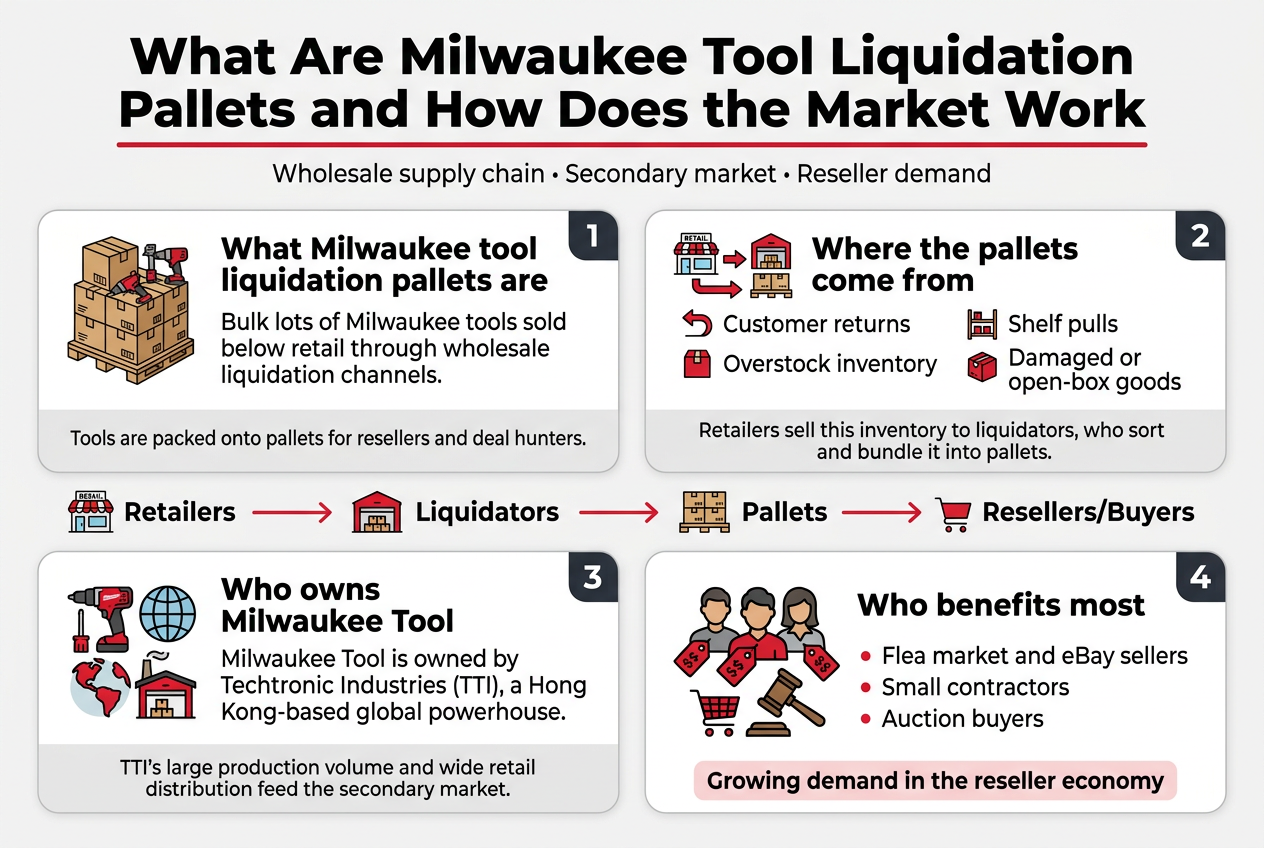
Milwaukee tool liquidation pallets are bulk lots of tools sold below retail through wholesale liquidation channels. Retailers, manufacturers, and warehouses offload excess, returned, or overstock inventory this way — packaging items onto pallets sold to resellers or deal hunters.

Where Milwaukee Liquidation Pallets Actually Come From (The Supply Chain)

These pallets originate from several key sources:

  • Customer returns from big-box retailers like Home Depot or Lowe’s

  • Overstock inventory from distribution centers

  • Shelf pulls — items removed to make room for newer models

  • Damaged or open-box goods that can’t be sold as new

Retailers sell this inventory to liquidators, who sort and bundle it into pallets for resale.

Who Owns Milwaukee Tools and How TTI’s Scale Feeds the Secondary Market

Milwaukee Tool is owned by Techtronic Industries (TTI), a Hong Kong-based global powerhouse. TTI’s massive production volume and wide retail distribution naturally generate significant return and overstock flow — directly fueling the secondary liquidation market with high-demand, brand-name inventory.

Current Market Trends and Who Benefits Most

Demand for Milwaukee tool liquidation pallets has grown alongside the reseller economy. Those who benefit most include:

  • Flea market and eBay sellers

  • Small contractors seeking discounted tools

  • Auction buyers looking for high-margin flips

Types of Milwaukee Tool Pallets Available for Purchase
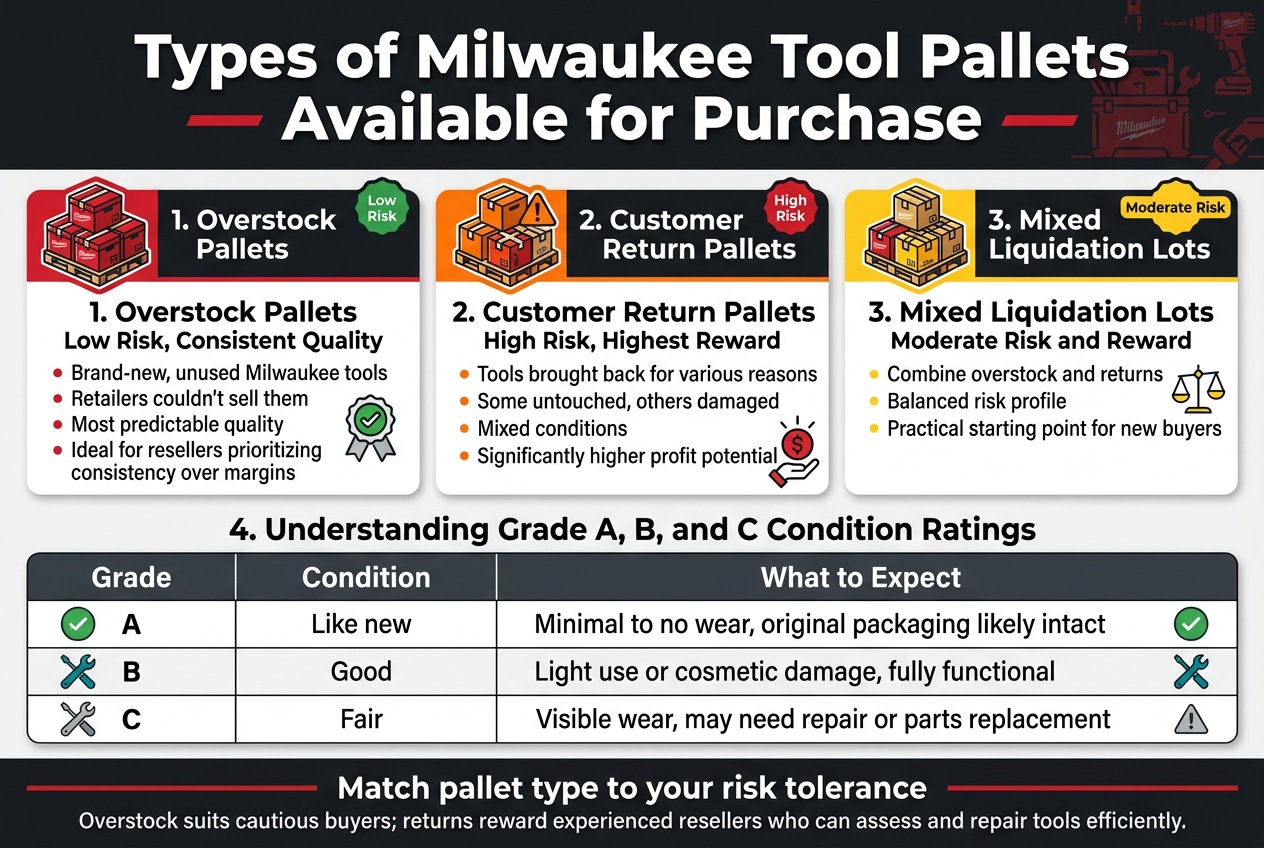
Create a full-bleed professional infographic in a 3:2 aspect ratio with a clean modern industrial style, using Milwaukee-inspired red, black, white, and gray colors. Use bold sans-serif typography, strong visual hierarchy, and wide horizontal sections with no vertical poster frame. Top header across the full width: Large bold title in white text on a black or dark charcoal banner: "Types of Milwaukee Tool Pallets Available for Purchase" Add small red accent lines and subtle tool-related graphics in the background. Main middle section: three wide side-by-side content cards with icons and risk labels. Left card, red and black color theme, icon of stacked unopened tool boxes: "1. Overstock Pallets" Subheading in smaller text: "Low Risk, Consistent Quality" Body text: "Brand-new, unused Milwaukee tools" "Retailers couldn't sell them" "Most predictable quality" "Ideal for resellers prioritizing consistency over margins" Add a green low-risk badge and a simple quality/check icon. Center card, orange and black color theme, icon of mixed tool boxes with a warning symbol: "2. Customer Return Pallets" Subheading in smaller text: "High Risk, Highest Reward" Body text: "Tools brought back for various reasons" "Some untouched, others damaged" "Mixed conditions" "Significantly higher profit potential" Add a red high-risk badge and a reward/profit icon. Right card, yellow and black color theme, icon of mixed boxes and balanced scale: "3. Mixed Liquidation Lots" Subheading in smaller text: "Moderate Risk and Reward" Body text: "Combine overstock and returns" "Balanced risk profile" "Practical starting point for new buyers" Add a yellow moderate-risk badge and a balanced scale icon. Bottom section spanning the width: A clean comparison table titled in bold: "4. Understanding Grade A, B, and C Condition Ratings" Use a three-column table with clear grid lines and small icons beside each grade. Table columns: "Grade" | "Condition" | "What to Expect" Row 1: "A" | "Like new" | "Minimal to no wear, original packaging likely intact" Use a green check icon. Row 2: "B" | "Good" | "Light use or cosmetic damage, fully functional" Use a blue or teal tool icon. Row 3: "C" | "Fair" | "Visible wear, may need repair or parts replacement" Use a gray wrench icon and small caution symbol. Footer callout bar across the bottom in dark charcoal with white text and red accent: "Match pallet type to your risk tolerance" Smaller text beneath: "Overstock suits cautious buyers; returns reward experienced resellers who can assess and repair tools efficiently." Use neat alignment, clear spacing, subtle shadows, and crisp infographic-style illustrations. Include only the visible text specified above.

A. Overstock Pallets: Low Risk, Consistent Quality

Overstock pallets contain brand-new, unused Milwaukee tools that retailers couldn’t sell. These offer the most predictable quality and are ideal for resellers prioritizing consistency over margins.

B. Customer Return Pallets: High Risk, Highest Reward

Customer return pallets include tools brought back for various reasons — some untouched, others damaged. When buying Milwaukee tool liquidation pallets of this type, expect mixed conditions but significantly higher profit potential.

C. Mixed Liquidation Lots: Moderate Risk and Reward

Mixed lots combine overstock and returns, offering a balanced risk profile. They’re a practical starting point for buyers new to liquidation purchasing.

D. Understanding Grade A, B, and C Condition Ratings

GradeConditionWhat to Expect
ALike newMinimal to no wear, original packaging likely intact
BGoodLight use or cosmetic damage, fully functional
CFairVisible wear, may need repair or parts replacement

With this in mind, matching pallet type to your risk tolerance is critical. Overstock suits cautious buyers; returns reward experienced resellers who can assess and repair tools efficiently.

What’s Inside a Milwaukee Tool Pallet: Sample Manifest Breakdown
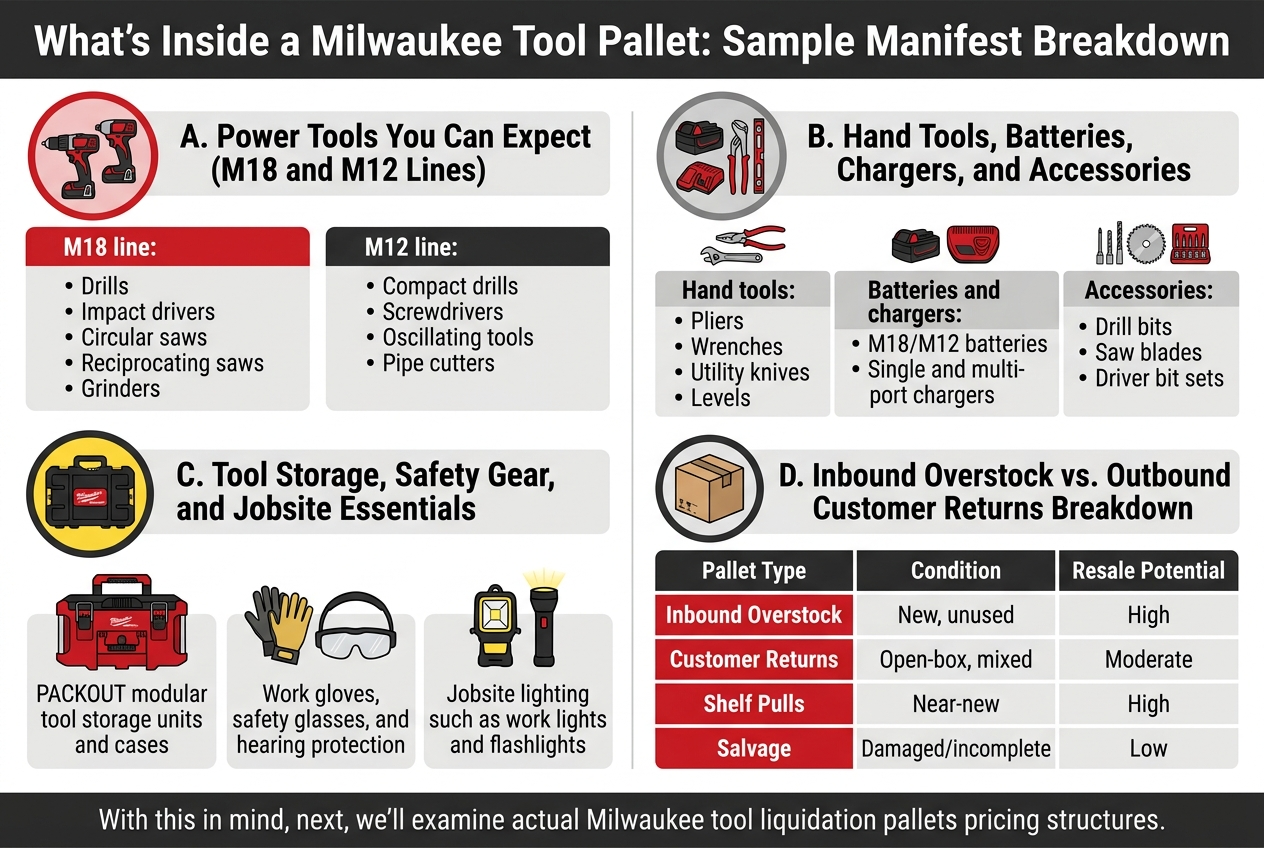
Create a clean, professional infographic illustration in a full-bleed 3:2 landscape layout with no border or inset frame. Use a modern industrial style with Milwaukee-inspired red, black, charcoal, white, and light gray accents, with subtle yellow highlights for safety items. Use bold sans-serif typography, strong visual hierarchy, and clear section blocks arranged in a wide multi-column layout. Top header spanning the full width: Title in large bold text: "What’s Inside a Milwaukee Tool Pallet: Sample Manifest Breakdown" Below the title, divide the infographic into four main horizontal content sections with clear labels, each with an icon and concise bullet lists. Section 1 on the upper left, with a red circular icon showing a cordless drill and impact driver: Heading text: "A. Power Tools You Can Expect (M18 and M12 Lines)" Two side-by-side sub-blocks: "M18 line:" - "Drills" - "Impact drivers" - "Circular saws" - "Reciprocating saws" - "Grinders" "M12 line:" - "Compact drills" - "Screwdrivers" - "Oscillating tools" - "Pipe cutters" Section 2 on the upper right, with a gray circular icon showing batteries, charger, and hand tools: Heading text: "B. Hand Tools, Batteries, Chargers, and Accessories" Use three compact icon-labeled rows or mini blocks: Hand tools: - "Pliers" - "Wrenches" - "Utility knives" - "Levels" Batteries and chargers: - "M18/M12 batteries" - "Single and multi-port chargers" Accessories: - "Drill bits" - "Saw blades" - "Driver bit sets" Section 3 across the lower left, with a black-and-yellow circular icon showing a PACKOUT case, gloves, safety glasses, and a flashlight: Heading text: "C. Tool Storage, Safety Gear, and Jobsite Essentials" Use three visual callouts: - "PACKOUT modular tool storage units and cases" - "Work gloves, safety glasses, and hearing protection" - "Jobsite lighting such as work lights and flashlights" Section 4 across the lower right, styled as a comparison table with four rows and two columns, with a small box icon at the top: Heading text: "D. Inbound Overstock vs. Outbound Customer Returns Breakdown" Table labels in clear readable text: Column headers: "Pallet Type" | "Condition" | "Resale Potential" Rows: - "Inbound Overstock" | "New, unused" | "High" - "Customer Returns" | "Open-box, mixed" | "Moderate" - "Shelf Pulls" | "Near-new" | "High" - "Salvage" | "Damaged/incomplete" | "Low" Add a thin bottom banner across the full width in dark gray with white text: "With this in mind, next, we'll examine actual Milwaukee tool liquidation pallets pricing structures." Use clean dividers between sections, balanced spacing, and simple vector-style tool illustrations. Keep all text crisp, legible, and aligned to a professional infographic grid.

A. Power Tools You Can Expect (M18 and M12 Lines)

Milwaukee tool liquidation pallets frequently contain items from their flagship cordless platforms:

  • M18 line: Drills, impact drivers, circular saws, reciprocating saws, grinders

  • M12 line: Compact drills, screwdrivers, oscillating tools, pipe cutters

B. Hand Tools, Batteries, Chargers, and Accessories

Beyond power tools, pallets typically include:

  • Hand tools: pliers, wrenches, utility knives, levels

  • M18/M12 batteries (various amp-hour ratings)

  • Single and multi-port chargers

  • Drill bits, saw blades, and driver bit sets

C. Tool Storage, Safety Gear, and Jobsite Essentials

Pallets may also contain higher-margin storage and safety items:

  • PACKOUT modular tool storage units and cases

  • Work gloves, safety glasses, and hearing protection

  • Jobsite lighting such as work lights and flashlights

D. Inbound Overstock vs. Outbound Customer Returns Breakdown

Understanding pallet composition helps set realistic expectations:

Pallet TypeConditionResale Potential
Inbound OverstockNew, unusedHigh
Customer ReturnsOpen-box, mixedModerate
Shelf PullsNear-newHigh
SalvageDamaged/incompleteLow

With this in mind, next, we’ll examine actual Milwaukee tool liquidation pallets pricing structures.

How Much Do Milwaukee Tool Liquidation Pallets Cost
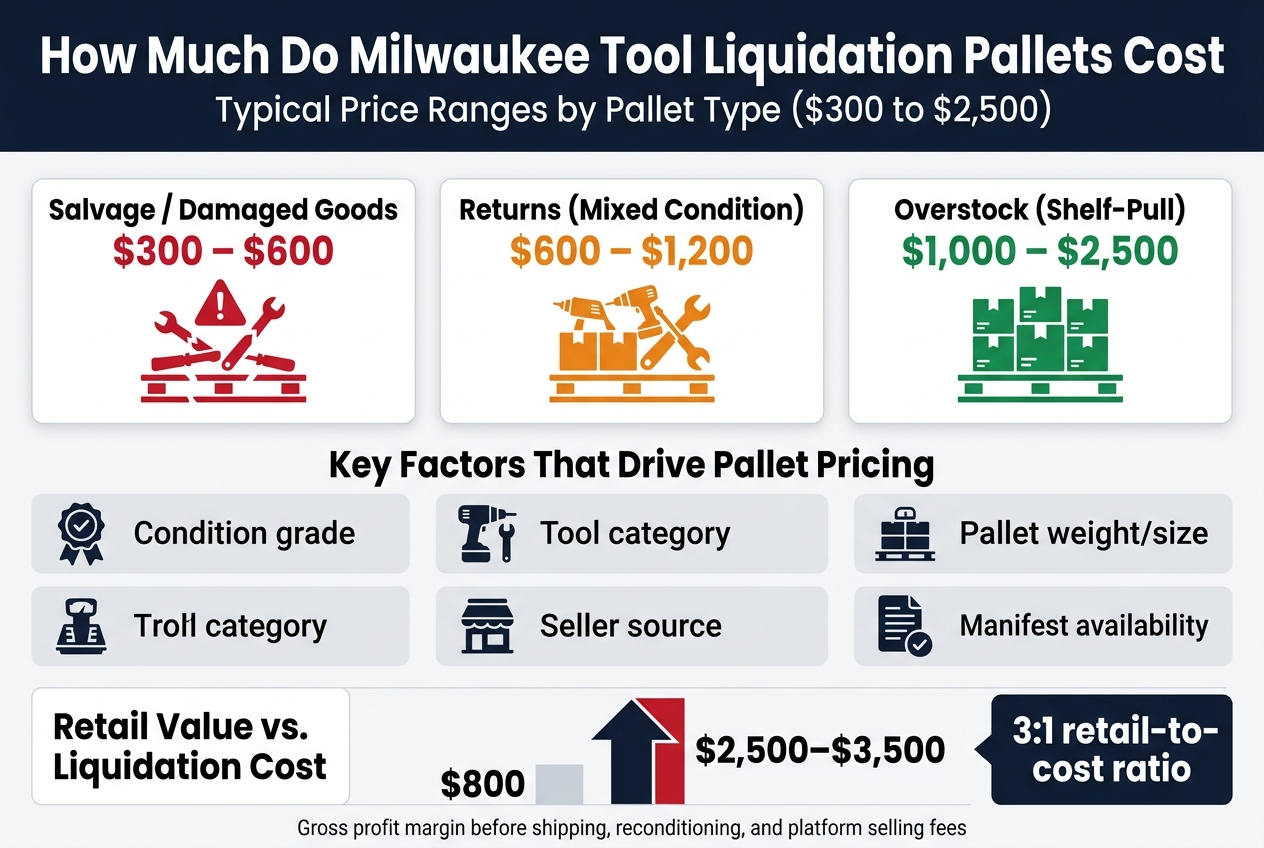
Create a clean professional infographic illustration in a 3:2 aspect ratio, full-bleed layout with no frame, using a dark navy, Milwaukee red, white, and light gray color palette. Use bold sans-serif typography with strong hierarchy. Top header across the full width: Large bold title text: "How Much Do Milwaukee Tool Liquidation Pallets Cost" Subtitle directly below in smaller text: "Typical Price Ranges by Pallet Type ($300 to $2,500)" Main layout: a wide 3-column section across the middle with three price cards, each with a simple tool pallet icon and color-coded price range. Left card: Title: "Salvage / Damaged Goods" Text: "$300 – $600" Visual: red warning-style icon, damaged pallet with broken tools. Center card: Title: "Returns (Mixed Condition)" Text: "$600 – $1,200" Visual: orange mixed-condition icon, pallet with mixed new and used tools. Right card: Title: "Overstock (Shelf-Pull)" Text: "$1,000 – $2,500" Visual: green premium icon, neatly stacked boxed tools on a pallet. Below the cards, create a horizontal section titled in bold: "Key Factors That Drive Pallet Pricing" Use five icon-labeled blocks arranged in two rows with clear spacing: 1. "Condition grade" with a quality badge icon 2. "Tool category" with a power drill and wrench icon 3. "Pallet weight/size" with a scale or stacked pallet icon 4. "Seller source" with a storefront or supplier icon 5. "Manifest availability" with a document and checkmark icon Bottom section as a wide profit comparison panel: Left side label in bold: "Retail Value vs. Liquidation Cost" Center visual: a large upward arrow or bar gap graphic showing a pallet cost of "$800" leading to retail value of "$2,500–$3,500" Right side bold callout box: "3:1 retail-to-cost ratio" Small footer text beneath: "Gross profit margin before shipping, reconditioning, and platform selling fees" Use clean grid alignment, strong contrast, modern infographic icons, and wide horizontal spacing. Include only the exact text shown above.

Typical Price Ranges by Pallet Type ($300 to $2,500)

Milwaukee tool liquidation pallets vary widely in price depending on condition and contents:

Pallet TypeEstimated Cost
Salvage/damaged goods$300 – $600
Returns (mixed condition)$600 – $1,200
Overstock (shelf-pull)$1,000 – $2,500

Key Factors That Drive Pallet Pricing

Several variables directly influence what you’ll pay for Milwaukee tool liquidation pallets:

  • Condition grade – Overstock pallets command higher prices than salvage lots

  • Tool category – Power tools and combo kits cost more than hand tools or accessories

  • Pallet weight/size – Heavier pallets with more units typically cost more

  • Seller source – Direct liquidators often offer better pricing than resellers

  • Manifest availability – Verified manifests increase buyer confidence and price

Understanding Retail Value vs. Liquidation Cost and Profit Potential

With this in mind, the real opportunity lies in the markup gap. A pallet purchased at $800 may carry $2,500–$3,500 in combined retail value. That spread represents your gross profit margin before accounting for:

  • Shipping and handling fees

  • Reconditioning or cleaning costs

  • Platform selling fees (eBay, Facebook Marketplace)

Targeting pallets with a 3:1 retail-to-cost ratio is a practical benchmark for sustainable resale profitability.

Who Should Buy Milwaukee Tool Liquidation Pallets
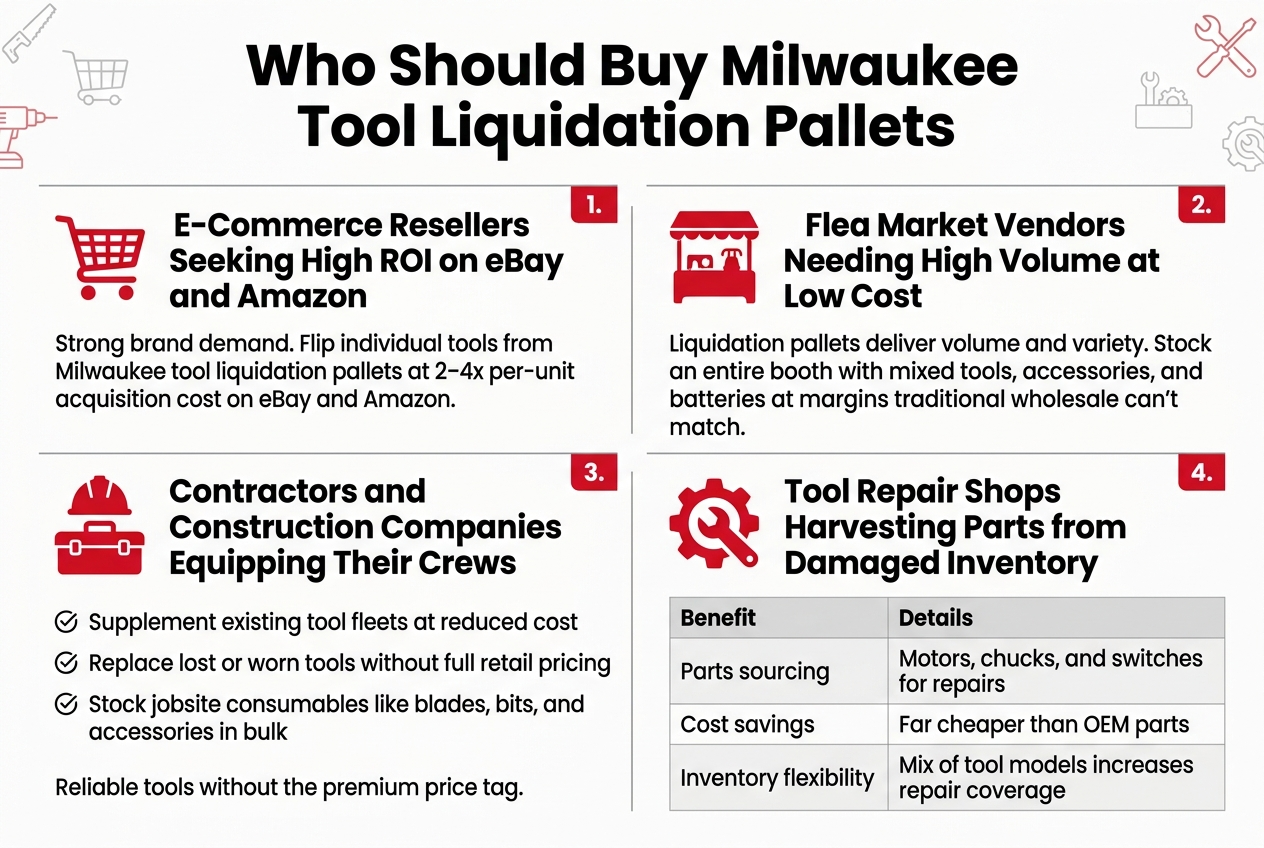
Create a clean, professional full-bleed infographic in a 3:2 landscape aspect ratio with a white background, Milwaukee-style red, black, and gray accents, bold sans-serif typography, and strong visual hierarchy. Place a large bold headline across the top: "Who Should Buy Milwaukee Tool Liquidation Pallets". Under the title, arrange four wide horizontal content blocks in a 2x2 grid with clear section headers, each with a distinct icon and short supporting text. Top left block: a red shopping cart icon and the heading "1. E-Commerce Resellers Seeking High ROI on eBay and Amazon". Add concise body text: "Strong brand demand. Flip individual tools from Milwaukee tool liquidation pallets at 2–4x per-unit acquisition cost on eBay and Amazon." Top right block: a red flea market booth icon and the heading "2. Flea Market Vendors Needing High Volume at Low Cost". Add body text: "Liquidation pallets deliver volume and variety. Stock an entire booth with mixed tools, accessories, and batteries at margins traditional wholesale can't match." Bottom left block: a red hard hat and toolbox icon and the heading "3. Contractors and Construction Companies Equipping Their Crews". Add three bullet points with check icons: "Supplement existing tool fleets at reduced cost"; "Replace lost or worn tools without full retail pricing"; "Stock jobsite consumables like blades, bits, and accessories in bulk". Add a small supporting line below: "Reliable tools without the premium price tag." Bottom right block: a red wrench and gear icon and the heading "4. Tool Repair Shops Harvesting Parts from Damaged Inventory". Add a simple two-column mini table with the header row "Benefit" and "Details". Include three rows: "Parts sourcing | Motors, chucks, and switches for repairs"; "Cost savings | Far cheaper than OEM parts"; "Inventory flexibility | Mix of tool models increases repair coverage". Use thin gray dividers between blocks, small red numbered badges for each section, and subtle tool-themed decorative line icons in the background. Keep the layout spacious, balanced, and easy to scan, with all text clearly legible and aligned within each section.

A. E-Commerce Resellers Seeking High ROI on eBay and Amazon

Milwaukee’s brand reputation drives strong online demand. Resellers can flip individual tools from Milwaukee tool liquidation pallets at 2–4x their per-unit acquisition cost on platforms like eBay and Amazon.

B. Flea Market Vendors Needing High Volume at Low Cost

Flea market sellers thrive on volume and variety — two things liquidation pallets deliver. A single pallet can stock an entire booth with mixed tools, accessories, and batteries at margins traditional wholesale can’t match.

C. Contractors and Construction Companies Equipping Their Crews

Contractors can use liquidation pallets to:

  • Supplement existing tool fleets at reduced cost

  • Replace lost or worn tools without full retail pricing

  • Stock jobsite consumables like blades, bits, and accessories in bulk

This makes pallets a practical choice for crews that need reliable tools without the premium price tag.

D. Tool Repair Shops Harvesting Parts from Damaged Inventory

Repair shops gain significant value by purchasing pallets with damaged or non-functional units. Key benefits include:

BenefitDetails
Parts sourcingMotors, chucks, and switches for repairs
Cost savingsFar cheaper than OEM parts
Inventory flexibilityMix of tool models increases repair coverage

How to Buy Milwaukee Tools Wholesale for the Best Value
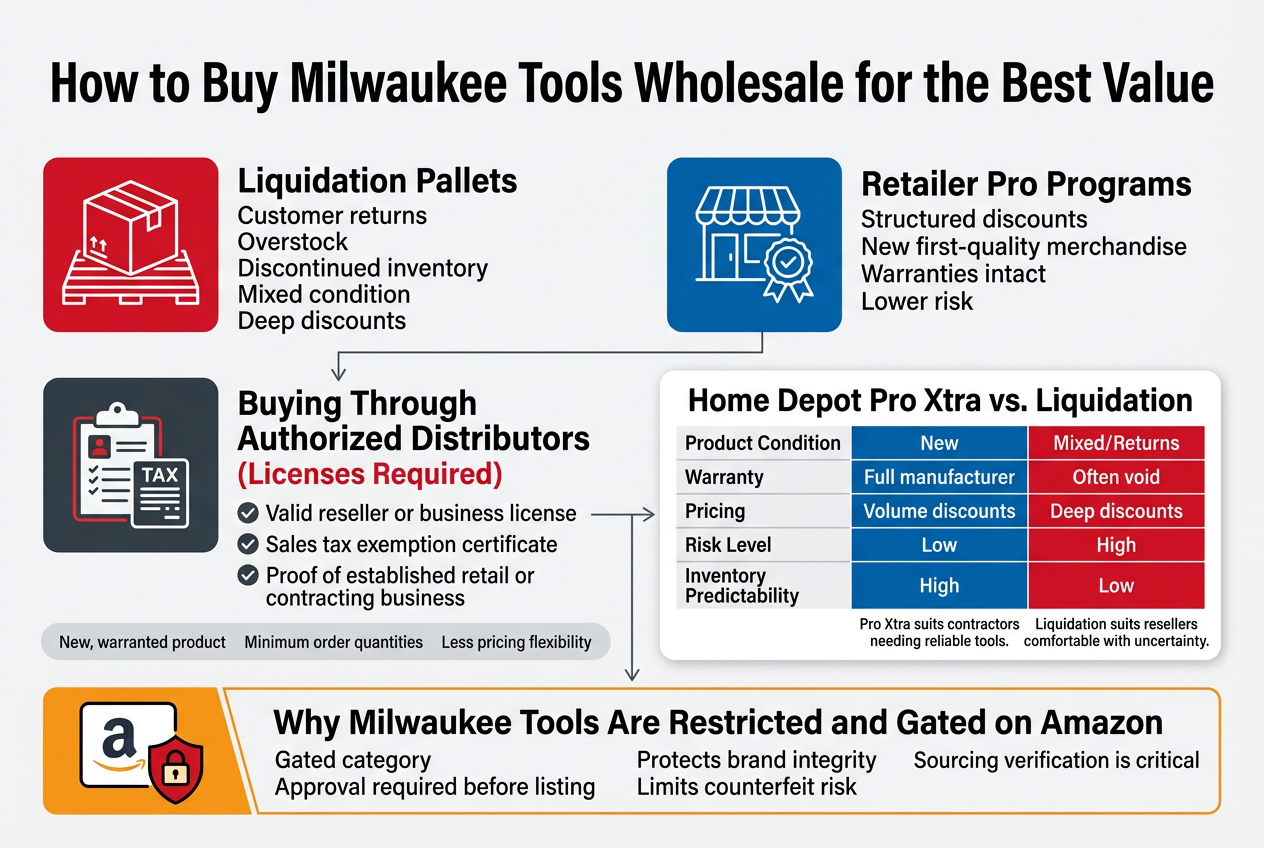
How to Buy Milwaukee Tools Wholesale for the Best Value

Difference Between Liquidation Pallets and Retailer Pro Programs

Milwaukee tool liquidation pallets come from customer returns, overstock, or discontinued inventory. Retailer pro programs, by contrast, offer structured discounts on new, first-quality merchandise with warranties intact.

How to Buy Wholesale Through Authorized Distributors (Licenses Required)

Purchasing Milwaukee tools through authorized distributors typically requires:

  • A valid reseller or business license

  • A sales tax exemption certificate

  • Proof of an established retail or contracting business

This route guarantees new, warranted product but involves minimum order quantities and less pricing flexibility than liquidation.

Home Depot Pro Xtra vs. Liquidation: Which Is Right for You

FactorHome Depot Pro XtraLiquidation Pallets
Product ConditionNewMixed/Returns
WarrantyFull manufacturerOften void
PricingVolume discountsDeep discounts
Risk LevelLowHigh
Inventory PredictabilityHighLow

Pro Xtra suits contractors needing reliable tools. Liquidation suits resellers comfortable with uncertainty.

Why Milwaukee Tools Are Restricted and Gated on Amazon

Milwaukee tools are a gated category on Amazon, meaning sellers must obtain approval before listing. This protects brand integrity and limits counterfeit risk, making sourcing verification critical for resellers pursuing this channel.

How to Find Legitimate Milwaukee Tool Pallet Sellers and Avoid Scams

MILWAUKEE 18V FUEL 11 Piece 3 x 5.0Ah Combo Kit Power Pack M18FPP11A3503B | How to Find Legitimate Milwaukee Tool Pallet Sellers and Avoid Scams

A. How to Verify a Seller’s Credibility and Physical Warehouse

Before purchasing Milwaukee tool liquidation pallets, confirm the seller operates a legitimate physical warehouse. Request the address and cross-check it on Google Maps. Reputable liquidators include:

  • Verifiable business registration

  • Transparent return policies

  • Customer reviews on third-party platforms

  • Active customer support channels

B. Why Manifests Are Essential and How to Use Them

A manifest lists every item in a pallet, including model numbers, quantities, and condition grades. Always request one before buying. Use it to:

  • Estimate resale value per item

  • Identify high-ticket tools included

  • Compare manifest accuracy against received goods

C. Red Flags That Signal a Scam or Counterfeit Product

Watch for these warning signs when evaluating sellers:

  • No manifest provided upon request

  • Prices dramatically below market value

  • Vague product descriptions with no brand specifics

  • Payment only via wire transfer or cryptocurrency

  • No physical address or warehouse photos

D. How to Verify Milwaukee Tool Authenticity Using Serial Numbers

With this in mind, always verify tools post-purchase. Milwaukee serial numbers can be cross-referenced through Milwaukee’s official website or customer service line. Counterfeit tools typically show:

  • Inconsistent font or logo quality

  • Missing or duplicate serial numbers

  • Poor build quality on housings and switches

Step-by-Step Guide to Reselling Milwaukee Tools from a Pallet Profitably
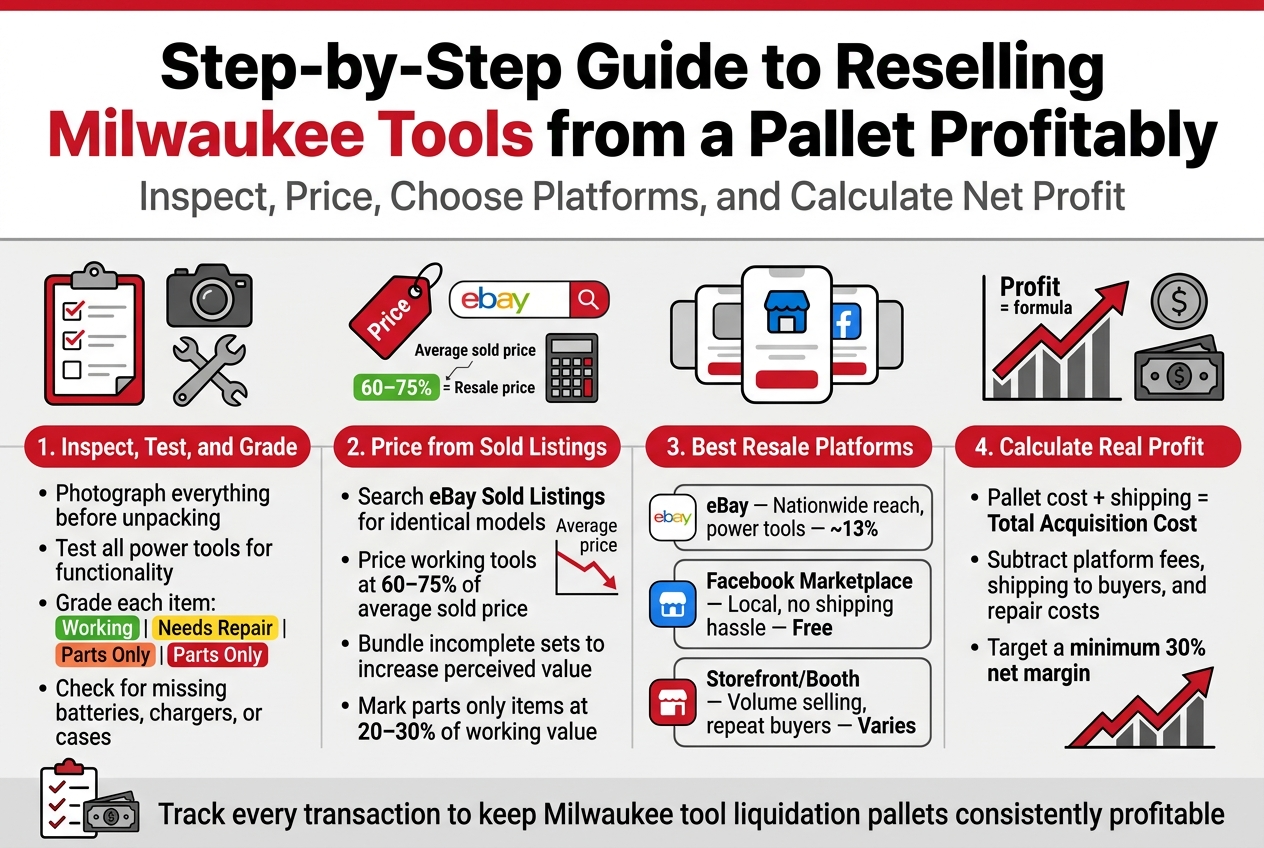
Step-by-Step Guide to Reselling Milwaukee Tools from a Pallet Profitably

Inspecting, Testing, and Grading Tools Upon Arrival

Once your Milwaukee tool liquidation pallet arrives, immediately:

  • Photograph everything before unpacking for dispute protection

  • Test all power tools for functionality

  • Grade each item: WorkingNeeds Repair, or Parts Only

  • Check for missing batteries, chargers, or cases

Pricing Strategies Based on Completed Sales Listings

Never price based on retail. Instead:

  • Search eBay → filter Sold Listings for identical models

  • Price working tools at 60–75% of average sold price

  • Bundle incomplete sets to increase perceived value

  • Mark “parts only” items separately at 20–30% of working value

Best Platforms to Resell Milwaukee Tools

PlatformBest ForFee Estimate
eBayNationwide reach, power tools~13%
Facebook MarketplaceLocal, no shipping hassleFree
Storefront/BoothVolume selling, repeat buyersVaries

Realistic Profit Calculation

With this in mind, always calculate net return before purchasing:

  • Pallet cost + shipping = Total Acquisition Cost

  • Subtract platform fees, shipping to buyers, and repair costs

  • Target a minimum 30% net margin to justify the investment

Tracking every transaction ensures your Milwaukee tool liquidation pallets remain consistently profitable.

Key Risks and Trade-Offs of Buying Milwaukee Liquidation Pallets
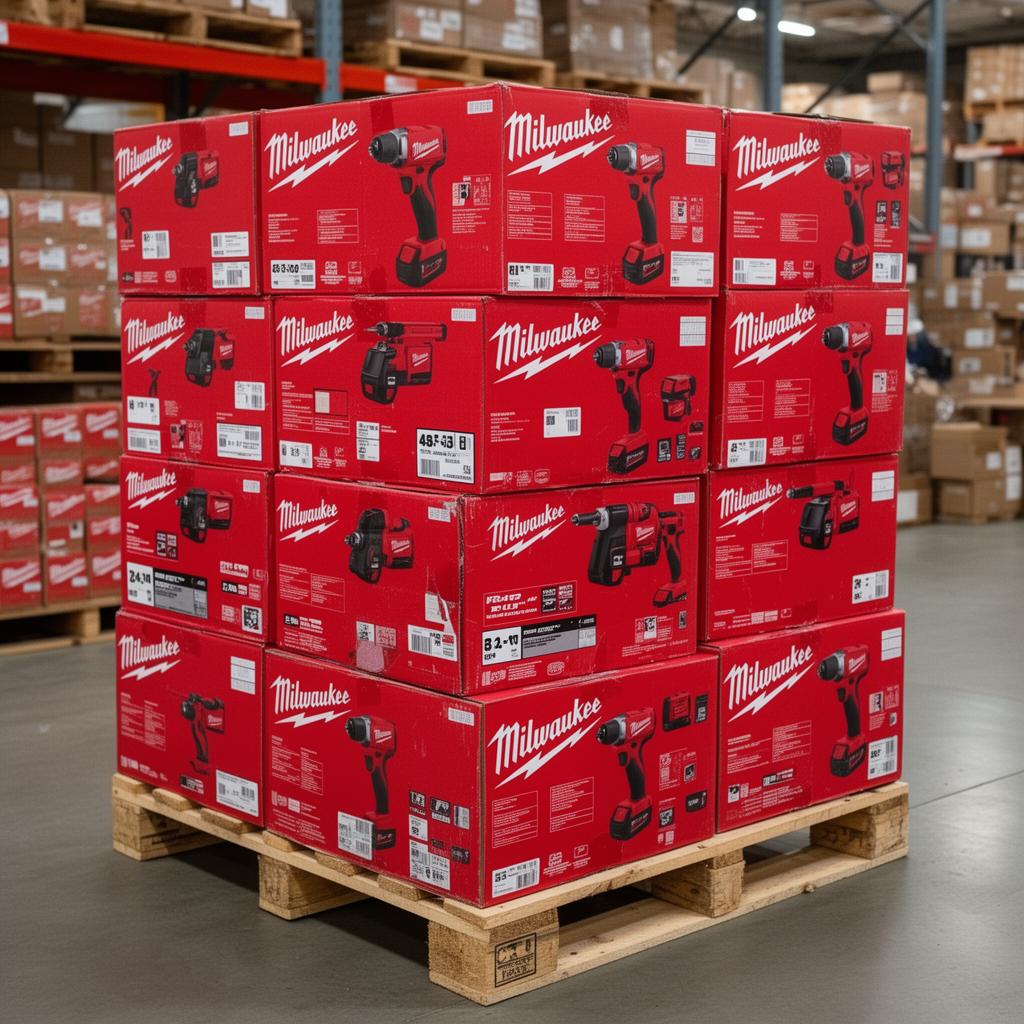
Milwaukee Tools for Sale - Wholesale Pallets & Key Risks and Trade-Offs of Buying Milwaukee Liquidation Pallets

A. No Manufacturer Warranty on Liquidation Purchases: What to Expect

Milwaukee Tool’s manufacturer warranty applies exclusively to products purchased through authorized dealers. When buying Milwaukee tool liquidation pallets, tools are sold as-is — meaning no warranty protection transfers to you or your customers.

Expect a mix of:

  • Open-box items with intact functionality

  • Returned tools with unknown usage history

  • Damaged or missing-component units

B. Handling Returns and Post-Purchase Support as a Reseller

As a reseller, you absorb all post-sale risk. Key considerations include:

  • Building a personal return policy funded from your margins

  • Setting aside a defect reserve (typically 10–20% of inventory value)

  • Disclosing tool condition clearly to buyers to minimize disputes

Customer trust depends entirely on your transparency, not Milwaukee’s brand support.

C. Authorized Dealer Purchase vs. Liquidation Pallet: Full Comparison

FactorAuthorized DealerLiquidation Pallet
Manufacturer Warranty✅ Yes❌ No
Price Per UnitHigherSignificantly Lower
Condition GuaranteeNew/SealedAs-Is
Resale Margin PotentialLowerHigher
Inventory RiskMinimalModerate–High

With this in mind, liquidation pallets offer strong margin potential — but only when you account for condition variability and the complete absence of manufacturer-backed support.

7 FAQ
Create a clean, professional full-bleed infographic illustration in a 3:2 aspect ratio with a wide horizontal layout, no border, no poster frame, and no narrow centered stack. Use a modern sans-serif font, bold dark navy title, white background with Milwaukee-inspired red accents, black text, light gray section boxes, and blue/green/yellow status icons. Top center: large bold heading text in a red banner, exact text: "7 FAQ" Below the heading, arrange seven wide FAQ blocks in a 2-column grid with the last block spanning the full width at the bottom. Each block should have a numbered circle icon, a simple matching icon, a bold question header, and short answer text. Use clear visual hierarchy and generous spacing. Top left block: Red circle number 1 with a dollar sign and tool icon. Exact text: "Are Milwaukee tool liquidation pallets worth buying?" "Yes, if you know what you're doing. Margins can be strong, but success depends on buying from reputable sources and understanding condition grades before spending money." Top right block: Red circle number 2 with a warehouse and shipping box icon. Exact text: "Can I buy Milwaukee tool liquidation pallets directly from Milwaukee?" "Milwaukee doesn't sell liquidation pallets directly to the public. Their overstock and returns flow through authorized liquidators like B-Stock, BULQ, and Direct Liquidation." Middle left block: Red circle number 3 with a clipboard and checkmark icon. Exact text: "What condition are tools typically in?" "Grade A – Like new, minimal use" "Grade B – Functional, visible wear" "Grade C – Needs repair or parts" "Salvage – For parts only" "Always check the manifest and condition grade before buying." Middle right block: Red circle number 4 with a price tag icon. Exact text: "How much does a pallet of Milwaukee tools cost?" "Pallets typically range from $500 to $5,000+, depending on the source, size, and condition grade." Lower left block: Red circle number 5 with a legal scale icon. Exact text: "Is reselling Milwaukee liquidation tools legal?" "Absolutely. Buying and reselling liquidation merchandise is completely legal under the first-sale doctrine." Lower right block: Red circle number 6 with a crossed-out wrench and warranty badge icon. Exact text: "Do pallets come with warranties?" "No. Liquidation purchases are almost always sold as-is with no manufacturer warranty." Bottom full-width block: Red circle number 7 with a warning triangle and magnifying glass icon. Exact text: "What's the biggest mistake new buyers make?" "Overpaying without checking the manifest. Always verify what's in the pallet and factor in repair costs before committing." Add subtle background illustrations of stacked tool boxes, cordless drills, and pallet shipping boxes in light gray behind the blocks. Use strong visual separation with thin lines or card shadows. Keep all text crisp, readable, and correctly spelled.

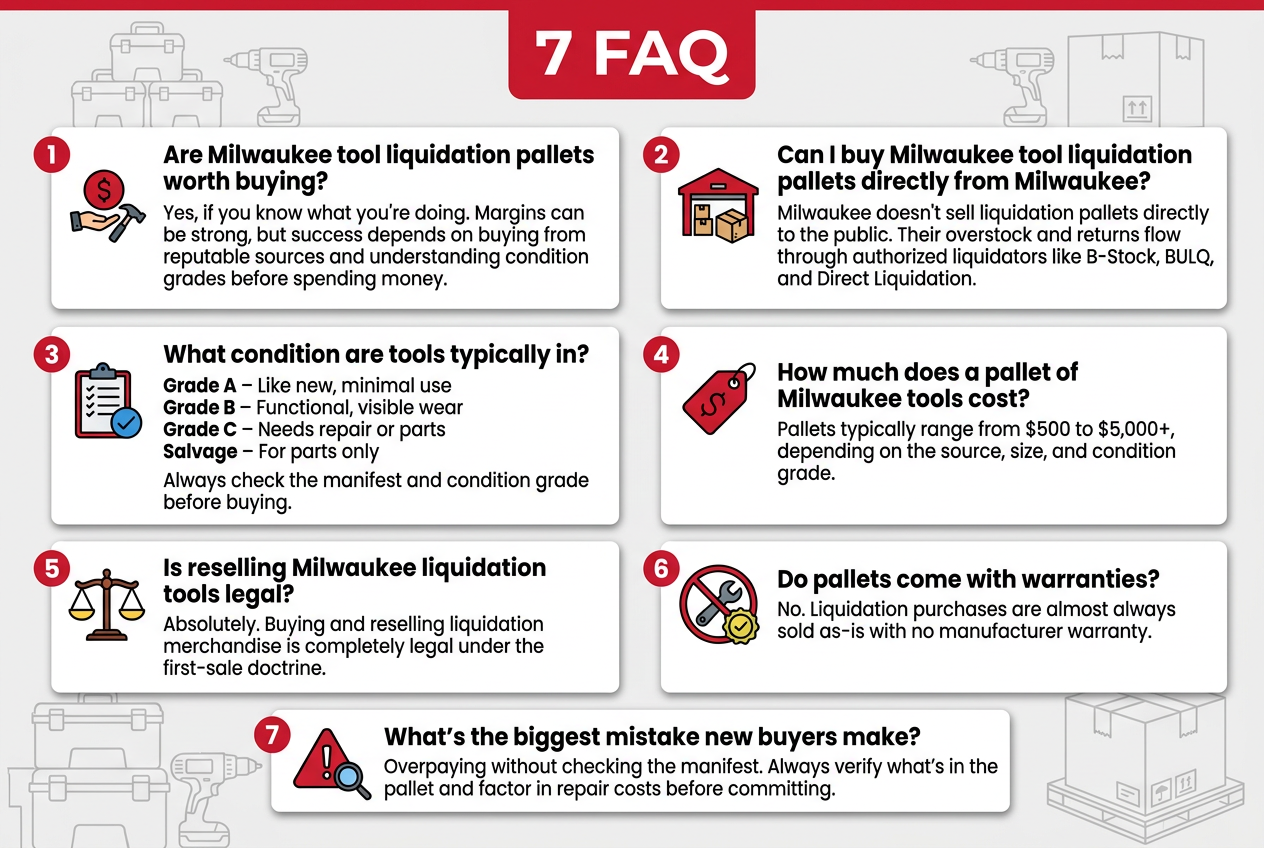
Are Milwaukee tool liquidation pallets worth buying?

Yes, if you know what you’re doing. Margins can be strong, but success depends on buying from reputable sources and understanding condition grades before spending money.

Can I buy Milwaukee tool liquidation pallets directly from Milwaukee?

Milwaukee doesn’t sell liquidation pallets directly to the public. Their overstock and returns flow through authorized liquidators like B-Stock, BULQ, and Direct Liquidation.

What condition are tools typically in?

Conditions vary widely:

  • Grade A – Like new, minimal use

  • Grade B – Functional, visible wear

  • Grade C – Needs repair or parts

  • Salvage – For parts only

Always check the manifest and condition grade before buying.

How much does a pallet of Milwaukee tools cost?

Pallets typically range from $500 to $5,000+, depending on the source, size, and condition grade.

Is reselling Milwaukee liquidation tools legal?

Absolutely. Buying and reselling liquidation merchandise is completely legal under the first-sale doctrine.

Do pallets come with warranties?

No. Liquidation purchases are almost always sold as-is with no manufacturer warranty.

What’s the biggest mistake new buyers make?

Overpaying without checking the manifest. Always verify what’s in the pallet and factor in repair costs before committing.
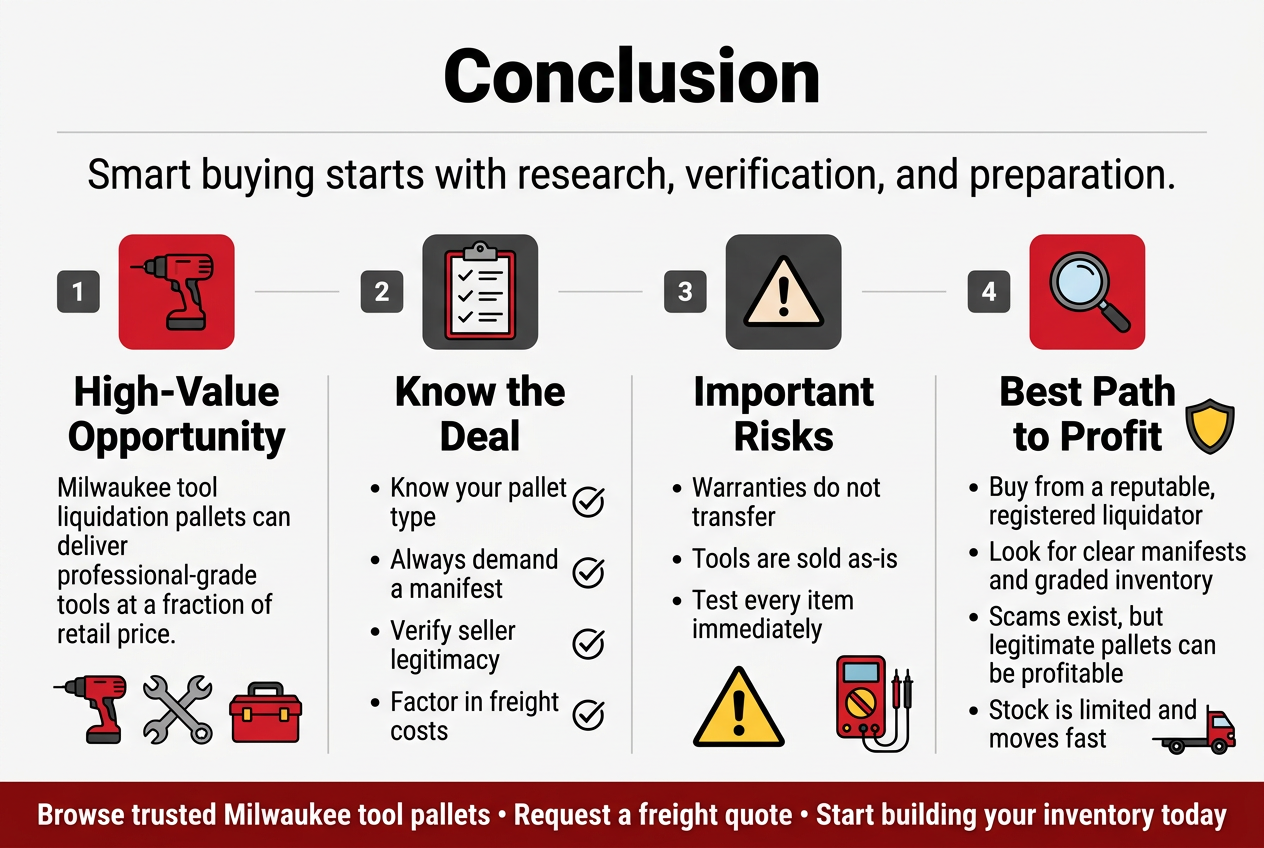
Create a clean, professional infographic in a 3:2 aspect ratio with a full-bleed layout, modern flat design, white background with Milwaukee red, black, dark gray, and accent yellow. Use a bold sans-serif title at the top: "Conclusion". Place a wide subtitle line beneath: "Smart buying starts with research, verification, and preparation." Organize the infographic into 4 horizontal sections across the center with clear numbered blocks and icons: 1) Left block with a red tool icon and bold heading: "High-Value Opportunity" Body text: "Milwaukee tool liquidation pallets can deliver professional-grade tools at a fraction of retail price." Add small supporting icons: drill, wrench, toolbox. 2) Center-left block with a clipboard icon and bold heading: "Know the Deal" Body text in short bullets: "• Know your pallet type" "• Always demand a manifest" "• Verify seller legitimacy" "• Factor in freight costs" Use checkmark icons beside each bullet. 3) Center-right block with a warning triangle icon and bold heading: "Important Risks" Body text in short bullets: "• Warranties do not transfer" "• Tools are sold as-is" "• Test every item immediately" Use a caution symbol and a testing multimeter icon. 4) Right block with a magnifying glass icon and bold heading: "Best Path to Profit" Body text in short bullets: "• Buy from a reputable, registered liquidator" "• Look for clear manifests and graded inventory" "• Scams exist, but legitimate pallets can be profitable" "• Stock is limited and moves fast" Use a shield icon and a freight truck icon. At the bottom, place a wide call-to-action bar in dark red with white text: "Browse trusted Milwaukee tool pallets • Request a freight quote • Start building your inventory today" Use strong visual hierarchy, clean spacing, subtle dividers between sections, and minimal decorative lines. Keep all text crisp and readable, with icons aligned to each section title. No frame, no border, no poster mockup, just the infographic filling the canvas.

Milwaukee tool liquidation pallets offer a genuine opportunity to access high-value, professional-grade tools at a fraction of their retail price. Whether you are a reseller looking for strong margins, a contractor outfitting your crew on a budget, or a DIY enthusiast building your workshop, understanding the market is what separates a smart buy from a costly mistake. The key lessons are simple: know your pallet type, always demand a manifest, verify your seller’s legitimacy, and factor in freight costs before committing to any purchase. Remember that warranties do not transfer through liquidation channels, and tools are sold as-is, so testing every item immediately upon arrival is non-negotiable.

The liquidation market rewards those who do their homework. Scams exist, but so do legitimate, manifested pallets with real profit potential. By sourcing from a reputable, registered liquidator that provides clear manifests and graded inventory, you dramatically reduce your risk and improve your chances of a profitable outcome. If you are ready to take the next step, browse available Milwaukee tool pallets from a trusted source, request a freight quote, and start building your inventory today. Stock is limited and moves fast, so acting with confidence and preparation is your biggest advantage.

Leave a Reply

Your email address will not be published. Required fields are marked *