Blog
Milwaukee tool liquidation pallets wholesale amazon

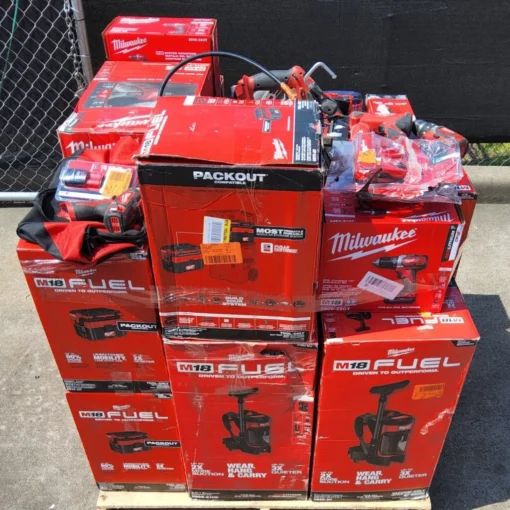
Milwaukee tool liquidation pallets wholesale amazon
Milwaukee Tool Liquidation Pallets: What You Need to Know Before You Buy
If you’ve been searching for Milwaukee tool liquidation pallets wholesale, you already know the appeal — premium tools at a fraction of retail price. But the market moves fast, the risks are real, and not every deal is what it looks like on the surface.
This guide is for resellers, contractors, and serious bargain hunters who want to buy smart, not just cheap. Whether you’re building an eBay store, stocking a job site crew, or sourcing inventory for a flea market booth, the same rules apply: know what you’re buying, who you’re buying from, and what the numbers actually look like after fees and freight.
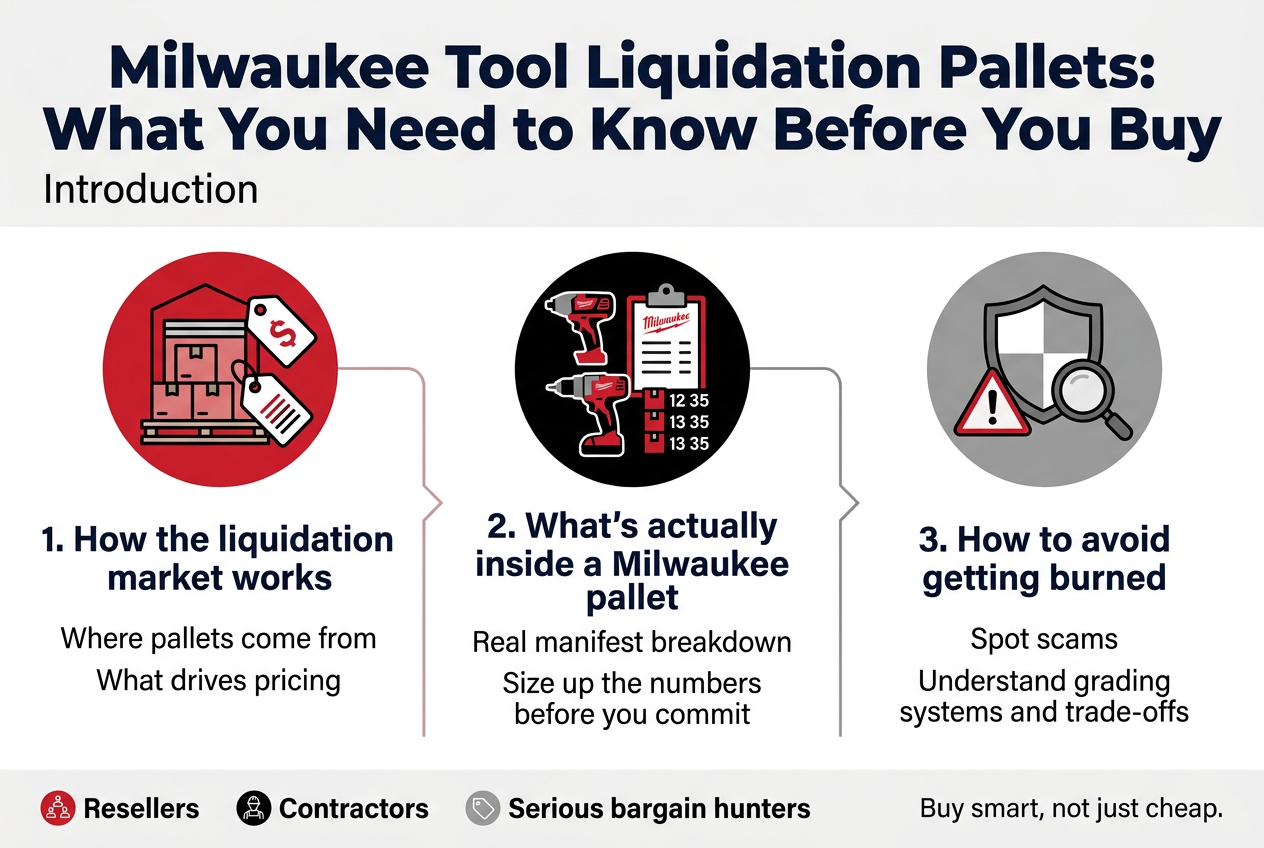
Here’s what we’ll cover:
How the liquidation market works — where these pallets come from and what drives the pricing
What’s actually inside a Milwaukee pallet — a real manifest breakdown so you can size up the numbers before you commit
How to avoid getting burned — spotting scams, understanding grading systems, and knowing the trade-offs before you spend a dollar
Let’s get into it.
What Are Milwaukee Tool Liquidation Pallets and How Does the Market Work
Definition of Tool Pallets and the Wholesale Liquidation Market
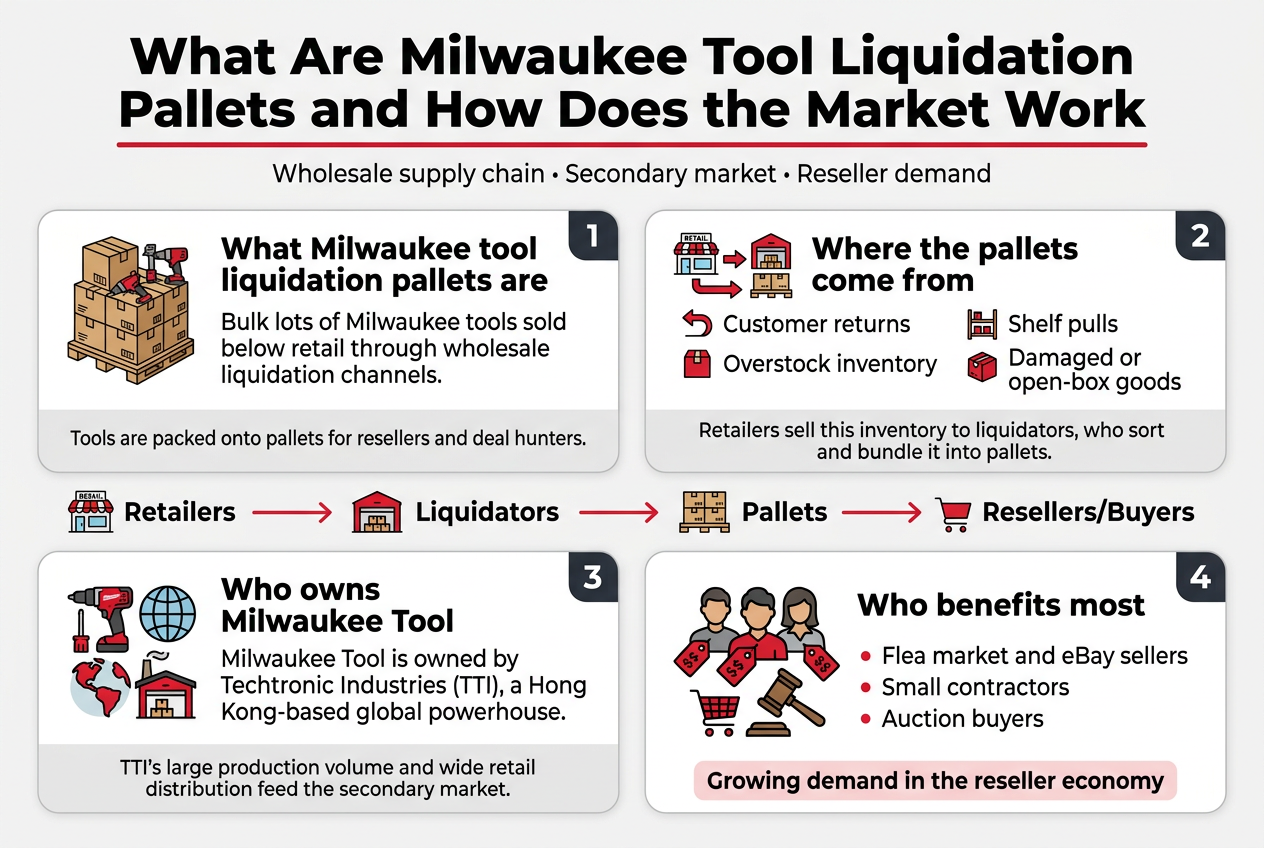
Milwaukee tool liquidation pallets are bulk lots of tools sold below retail through wholesale liquidation channels. Retailers, manufacturers, and warehouses offload excess, returned, or overstock inventory this way — packaging items onto pallets sold to resellers or deal hunters.
Where Milwaukee Liquidation Pallets Actually Come From (The Supply Chain)
These pallets originate from several key sources:
Customer returns from big-box retailers like Home Depot or Lowe’s
Overstock inventory from distribution centers
Shelf pulls — items removed to make room for newer models
Damaged or open-box goods that can’t be sold as new
Retailers sell this inventory to liquidators, who sort and bundle it into pallets for resale.
Who Owns Milwaukee Tools and How TTI’s Scale Feeds the Secondary Market
Milwaukee Tool is owned by Techtronic Industries (TTI), a Hong Kong-based global powerhouse. TTI’s massive production volume and wide retail distribution naturally generate significant return and overstock flow — directly fueling the secondary liquidation market with high-demand, brand-name inventory.
Current Market Trends and Who Benefits Most
Demand for Milwaukee tool liquidation pallets has grown alongside the reseller economy. Those who benefit most include:
Flea market and eBay sellers
Small contractors seeking discounted tools
Auction buyers looking for high-margin flips
Types of Milwaukee Tool Pallets Available for Purchase
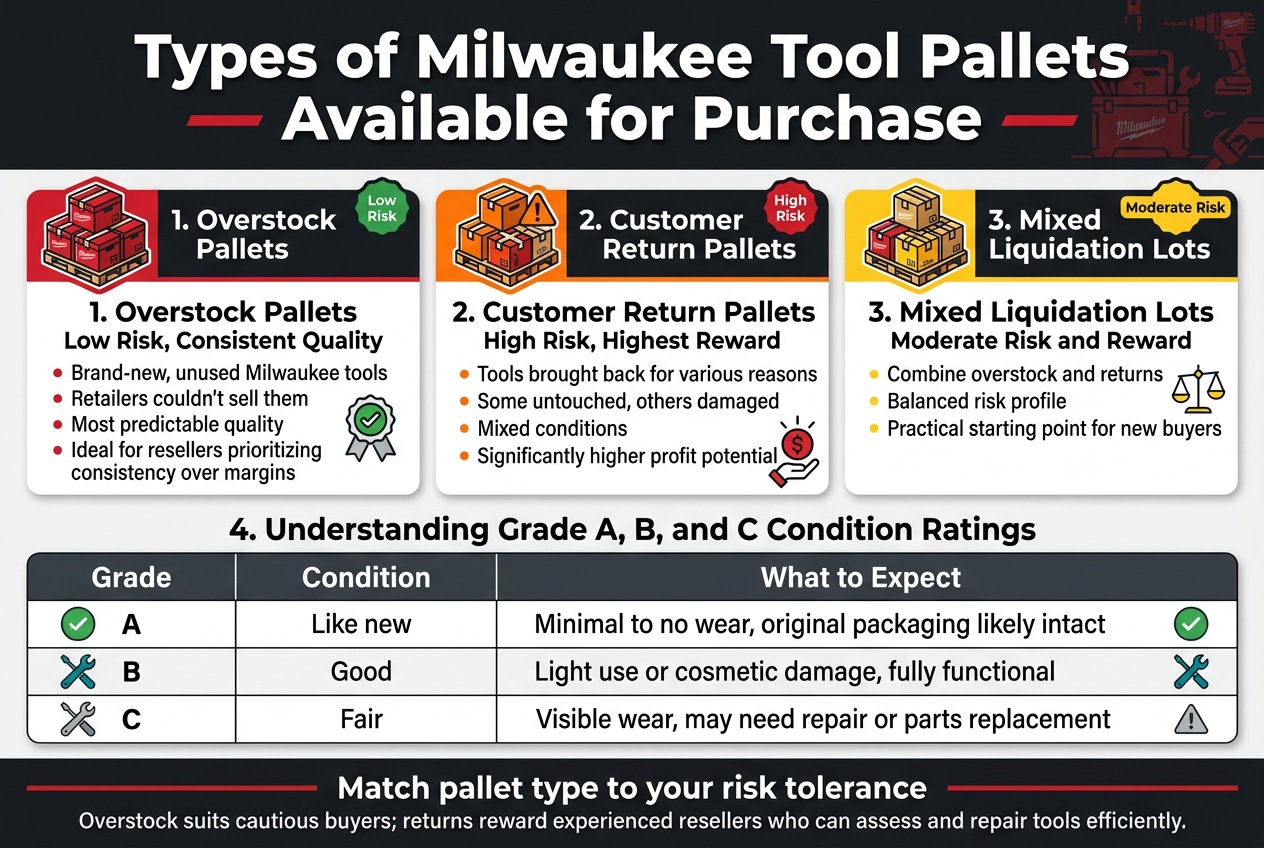
A. Overstock Pallets: Low Risk, Consistent Quality
Overstock pallets contain brand-new, unused Milwaukee tools that retailers couldn’t sell. These offer the most predictable quality and are ideal for resellers prioritizing consistency over margins.
B. Customer Return Pallets: High Risk, Highest Reward
Customer return pallets include tools brought back for various reasons — some untouched, others damaged. When buying Milwaukee tool liquidation pallets of this type, expect mixed conditions but significantly higher profit potential.
C. Mixed Liquidation Lots: Moderate Risk and Reward
Mixed lots combine overstock and returns, offering a balanced risk profile. They’re a practical starting point for buyers new to liquidation purchasing.
D. Understanding Grade A, B, and C Condition Ratings
| Grade | Condition | What to Expect |
|---|---|---|
| A | Like new | Minimal to no wear, original packaging likely intact |
| B | Good | Light use or cosmetic damage, fully functional |
| C | Fair | Visible wear, may need repair or parts replacement |
With this in mind, matching pallet type to your risk tolerance is critical. Overstock suits cautious buyers; returns reward experienced resellers who can assess and repair tools efficiently.
What’s Inside a Milwaukee Tool Pallet: Sample Manifest Breakdown
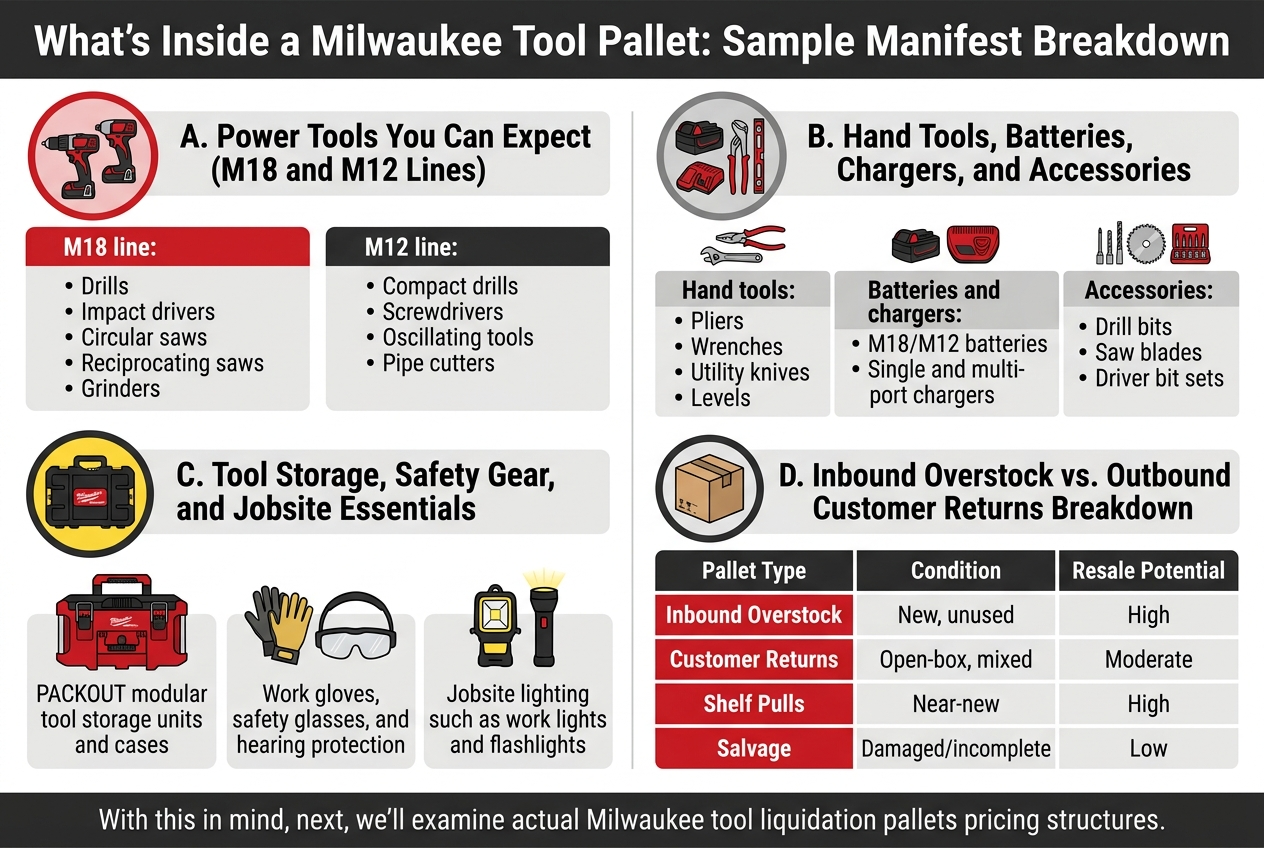
A. Power Tools You Can Expect (M18 and M12 Lines)
Milwaukee tool liquidation pallets frequently contain items from their flagship cordless platforms:
M18 line: Drills, impact drivers, circular saws, reciprocating saws, grinders
M12 line: Compact drills, screwdrivers, oscillating tools, pipe cutters
B. Hand Tools, Batteries, Chargers, and Accessories
Beyond power tools, pallets typically include:
Hand tools: pliers, wrenches, utility knives, levels
M18/M12 batteries (various amp-hour ratings)
Single and multi-port chargers
Drill bits, saw blades, and driver bit sets
C. Tool Storage, Safety Gear, and Jobsite Essentials
Pallets may also contain higher-margin storage and safety items:
PACKOUT modular tool storage units and cases
Work gloves, safety glasses, and hearing protection
Jobsite lighting such as work lights and flashlights
D. Inbound Overstock vs. Outbound Customer Returns Breakdown
Understanding pallet composition helps set realistic expectations:
| Pallet Type | Condition | Resale Potential |
|---|---|---|
| Inbound Overstock | New, unused | High |
| Customer Returns | Open-box, mixed | Moderate |
| Shelf Pulls | Near-new | High |
| Salvage | Damaged/incomplete | Low |
With this in mind, next, we’ll examine actual Milwaukee tool liquidation pallets pricing structures.
How Much Do Milwaukee Tool Liquidation Pallets Cost
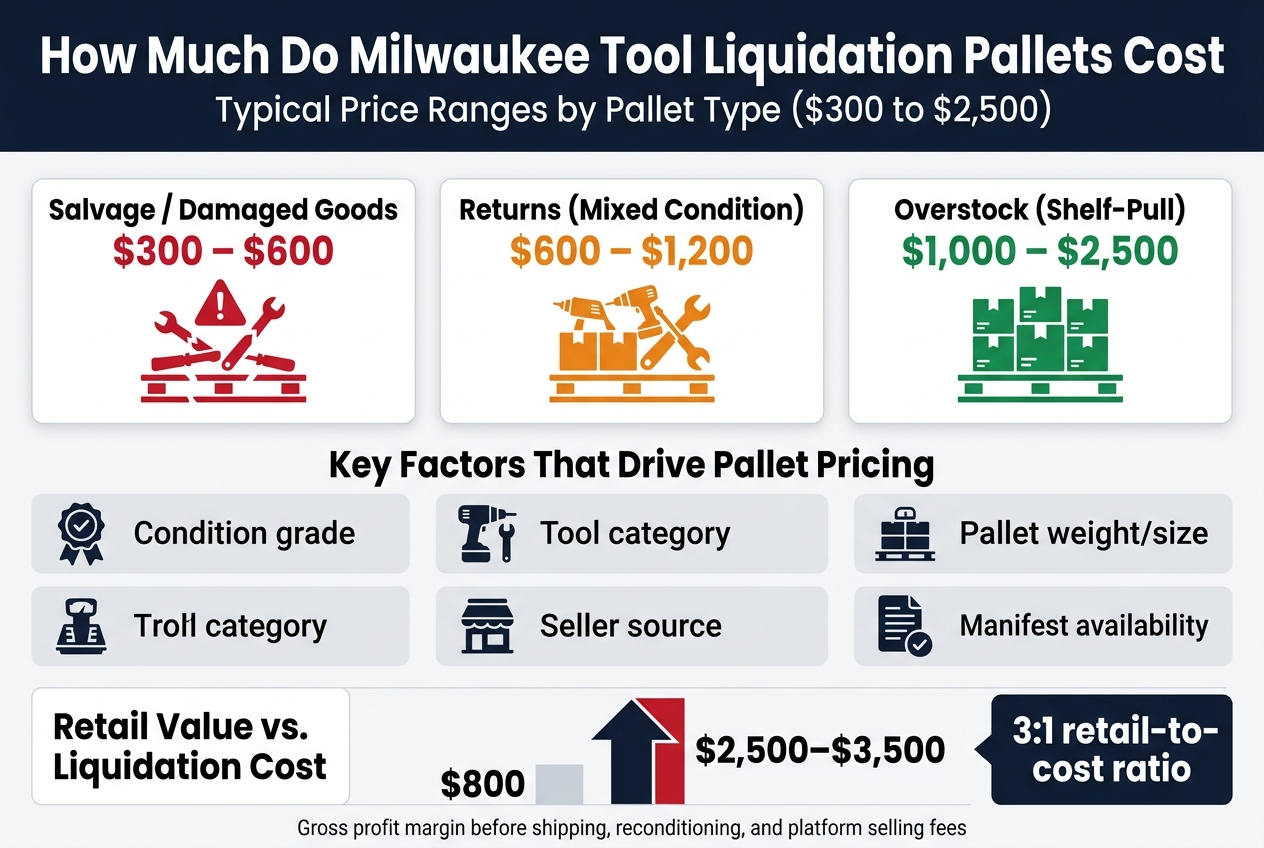
Typical Price Ranges by Pallet Type ($300 to $2,500)
Milwaukee tool liquidation pallets vary widely in price depending on condition and contents:
| Pallet Type | Estimated Cost |
|---|---|
| Salvage/damaged goods | $300 – $600 |
| Returns (mixed condition) | $600 – $1,200 |
| Overstock (shelf-pull) | $1,000 – $2,500 |
Key Factors That Drive Pallet Pricing
Several variables directly influence what you’ll pay for Milwaukee tool liquidation pallets:
Condition grade – Overstock pallets command higher prices than salvage lots
Tool category – Power tools and combo kits cost more than hand tools or accessories
Pallet weight/size – Heavier pallets with more units typically cost more
Seller source – Direct liquidators often offer better pricing than resellers
Manifest availability – Verified manifests increase buyer confidence and price
Understanding Retail Value vs. Liquidation Cost and Profit Potential
With this in mind, the real opportunity lies in the markup gap. A pallet purchased at $800 may carry $2,500–$3,500 in combined retail value. That spread represents your gross profit margin before accounting for:
Shipping and handling fees
Reconditioning or cleaning costs
Platform selling fees (eBay, Facebook Marketplace)
Targeting pallets with a 3:1 retail-to-cost ratio is a practical benchmark for sustainable resale profitability.
Who Should Buy Milwaukee Tool Liquidation Pallets
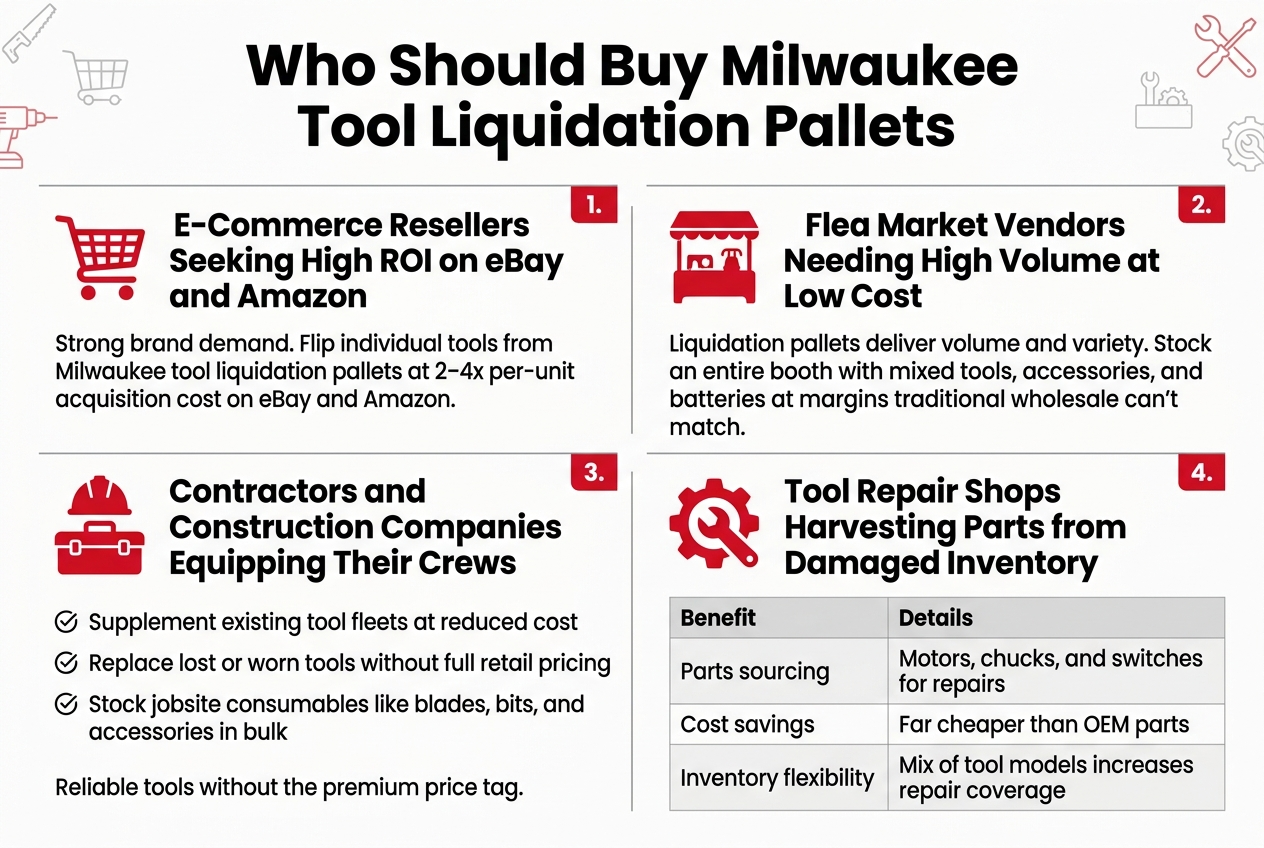
A. E-Commerce Resellers Seeking High ROI on eBay and Amazon
Milwaukee’s brand reputation drives strong online demand. Resellers can flip individual tools from Milwaukee tool liquidation pallets at 2–4x their per-unit acquisition cost on platforms like eBay and Amazon.
B. Flea Market Vendors Needing High Volume at Low Cost
Flea market sellers thrive on volume and variety — two things liquidation pallets deliver. A single pallet can stock an entire booth with mixed tools, accessories, and batteries at margins traditional wholesale can’t match.
C. Contractors and Construction Companies Equipping Their Crews
Contractors can use liquidation pallets to:
Supplement existing tool fleets at reduced cost
Replace lost or worn tools without full retail pricing
Stock jobsite consumables like blades, bits, and accessories in bulk
This makes pallets a practical choice for crews that need reliable tools without the premium price tag.
D. Tool Repair Shops Harvesting Parts from Damaged Inventory
Repair shops gain significant value by purchasing pallets with damaged or non-functional units. Key benefits include:
| Benefit | Details |
|---|---|
| Parts sourcing | Motors, chucks, and switches for repairs |
| Cost savings | Far cheaper than OEM parts |
| Inventory flexibility | Mix of tool models increases repair coverage |
How to Buy Milwaukee Tools Wholesale for the Best Value
Difference Between Liquidation Pallets and Retailer Pro Programs
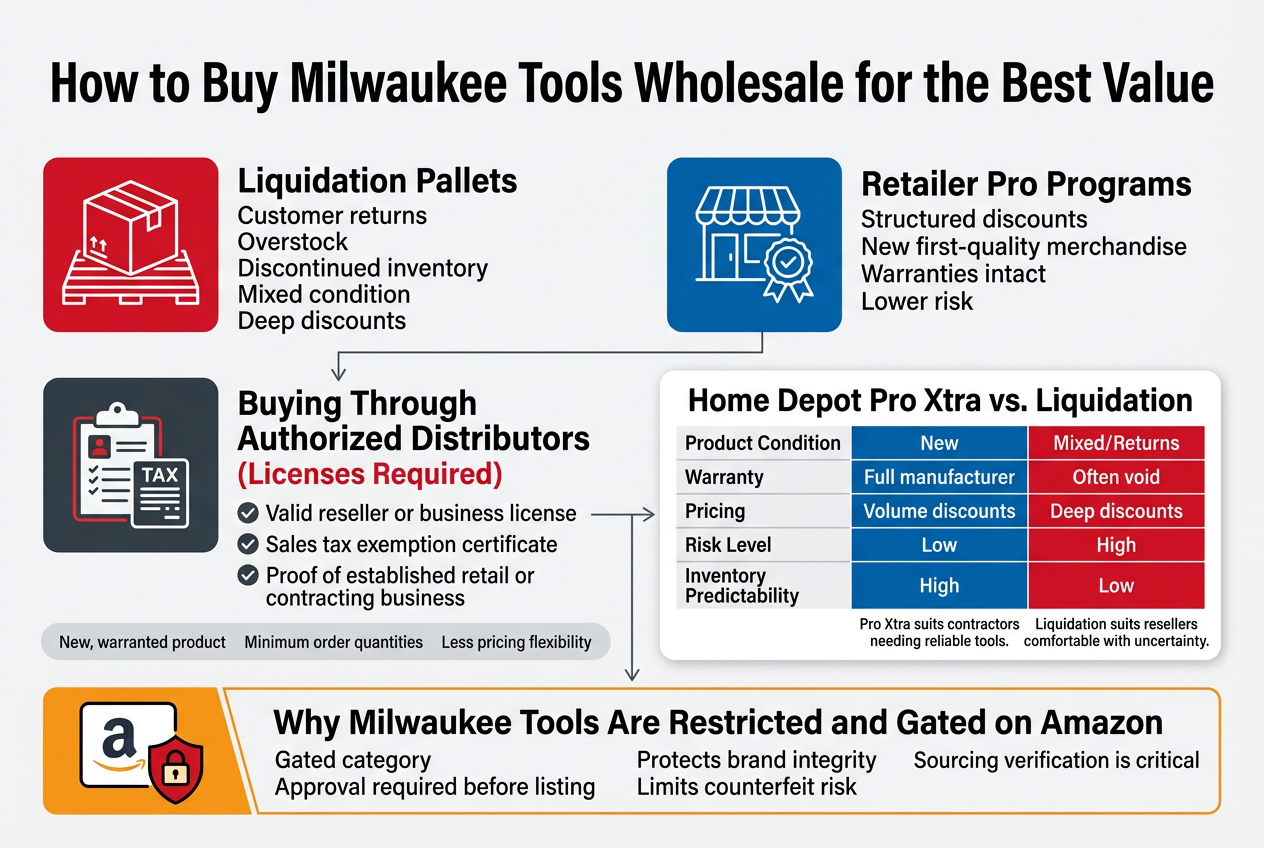
Milwaukee tool liquidation pallets come from customer returns, overstock, or discontinued inventory. Retailer pro programs, by contrast, offer structured discounts on new, first-quality merchandise with warranties intact.
How to Buy Wholesale Through Authorized Distributors (Licenses Required)
Purchasing Milwaukee tools through authorized distributors typically requires:
A valid reseller or business license
A sales tax exemption certificate
Proof of an established retail or contracting business
This route guarantees new, warranted product but involves minimum order quantities and less pricing flexibility than liquidation.
Home Depot Pro Xtra vs. Liquidation: Which Is Right for You
| Factor | Home Depot Pro Xtra | Liquidation Pallets |
|---|---|---|
| Product Condition | New | Mixed/Returns |
| Warranty | Full manufacturer | Often void |
| Pricing | Volume discounts | Deep discounts |
| Risk Level | Low | High |
| Inventory Predictability | High | Low |
Pro Xtra suits contractors needing reliable tools. Liquidation suits resellers comfortable with uncertainty.
Why Milwaukee Tools Are Restricted and Gated on Amazon
Milwaukee tools are a gated category on Amazon, meaning sellers must obtain approval before listing. This protects brand integrity and limits counterfeit risk, making sourcing verification critical for resellers pursuing this channel.
How to Find Legitimate Milwaukee Tool Pallet Sellers and Avoid Scams

A. How to Verify a Seller’s Credibility and Physical Warehouse
Before purchasing Milwaukee tool liquidation pallets, confirm the seller operates a legitimate physical warehouse. Request the address and cross-check it on Google Maps. Reputable liquidators include:
Verifiable business registration
Transparent return policies
Customer reviews on third-party platforms
Active customer support channels
B. Why Manifests Are Essential and How to Use Them
A manifest lists every item in a pallet, including model numbers, quantities, and condition grades. Always request one before buying. Use it to:
Estimate resale value per item
Identify high-ticket tools included
Compare manifest accuracy against received goods
C. Red Flags That Signal a Scam or Counterfeit Product
Watch for these warning signs when evaluating sellers:
No manifest provided upon request
Prices dramatically below market value
Vague product descriptions with no brand specifics
Payment only via wire transfer or cryptocurrency
No physical address or warehouse photos
D. How to Verify Milwaukee Tool Authenticity Using Serial Numbers
With this in mind, always verify tools post-purchase. Milwaukee serial numbers can be cross-referenced through Milwaukee’s official website or customer service line. Counterfeit tools typically show:
Inconsistent font or logo quality
Missing or duplicate serial numbers
Poor build quality on housings and switches
Step-by-Step Guide to Reselling Milwaukee Tools from a Pallet Profitably
Inspecting, Testing, and Grading Tools Upon Arrival
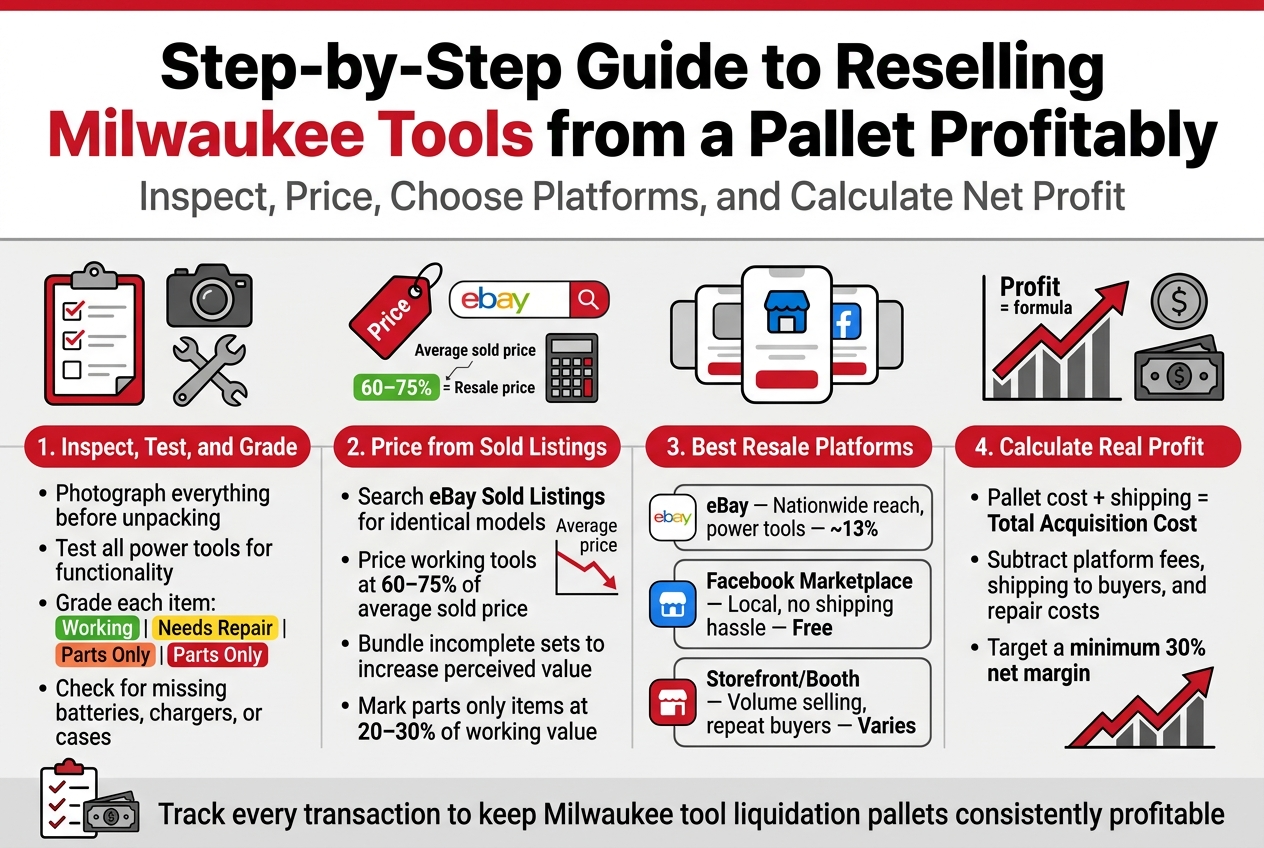
Once your Milwaukee tool liquidation pallet arrives, immediately:
Photograph everything before unpacking for dispute protection
Test all power tools for functionality
Grade each item: Working, Needs Repair, or Parts Only
Check for missing batteries, chargers, or cases
Pricing Strategies Based on Completed Sales Listings
Never price based on retail. Instead:
Search eBay → filter Sold Listings for identical models
Price working tools at 60–75% of average sold price
Bundle incomplete sets to increase perceived value
Mark “parts only” items separately at 20–30% of working value
Best Platforms to Resell Milwaukee Tools
| Platform | Best For | Fee Estimate |
|---|---|---|
| eBay | Nationwide reach, power tools | ~13% |
| Facebook Marketplace | Local, no shipping hassle | Free |
| Storefront/Booth | Volume selling, repeat buyers | Varies |
Realistic Profit Calculation
With this in mind, always calculate net return before purchasing:
Pallet cost + shipping = Total Acquisition Cost
Subtract platform fees, shipping to buyers, and repair costs
Target a minimum 30% net margin to justify the investment
Tracking every transaction ensures your Milwaukee tool liquidation pallets remain consistently profitable.
Key Risks and Trade-Offs of Buying Milwaukee Liquidation Pallets
A. No Manufacturer Warranty on Liquidation Purchases: What to Expect
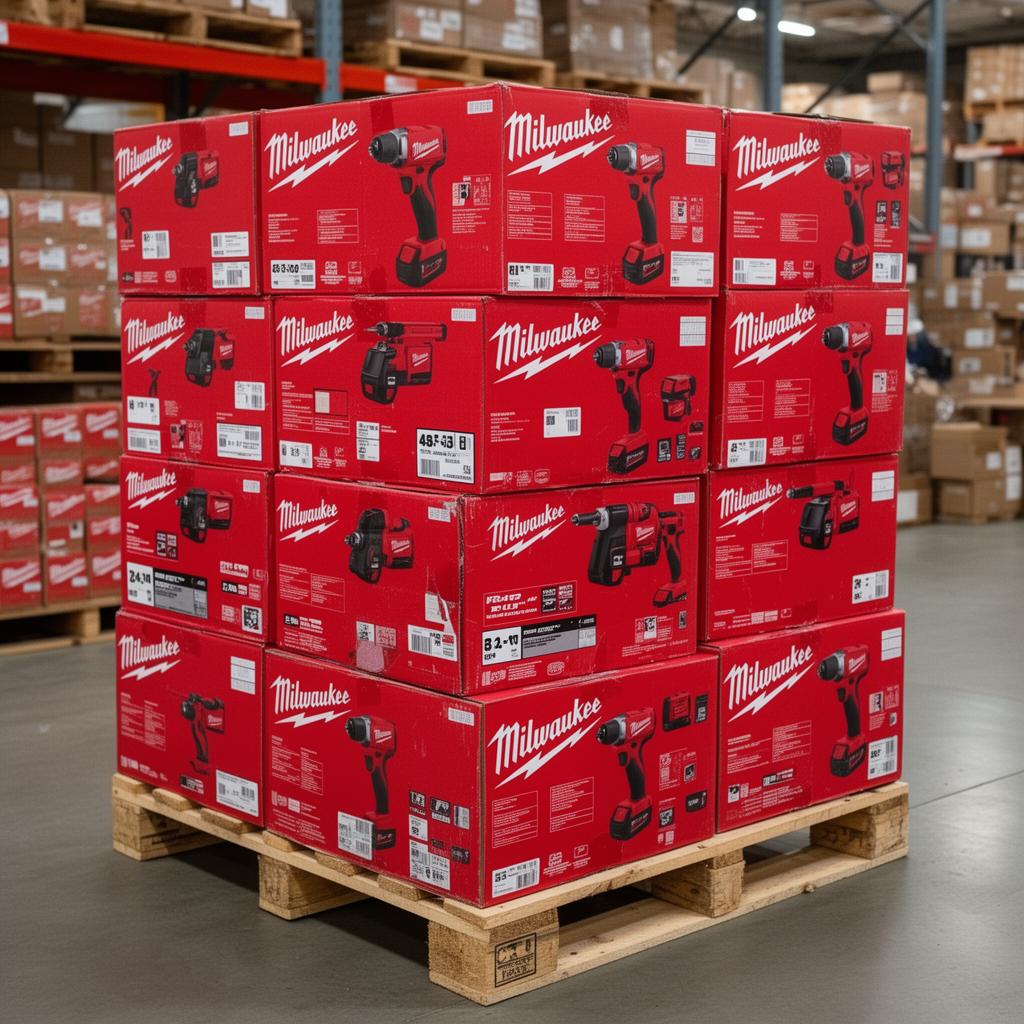
Milwaukee Tool’s manufacturer warranty applies exclusively to products purchased through authorized dealers. When buying Milwaukee tool liquidation pallets, tools are sold as-is — meaning no warranty protection transfers to you or your customers.
Expect a mix of:
Open-box items with intact functionality
Returned tools with unknown usage history
Damaged or missing-component units
B. Handling Returns and Post-Purchase Support as a Reseller
As a reseller, you absorb all post-sale risk. Key considerations include:
Building a personal return policy funded from your margins
Setting aside a defect reserve (typically 10–20% of inventory value)
Disclosing tool condition clearly to buyers to minimize disputes
Customer trust depends entirely on your transparency, not Milwaukee’s brand support.
C. Authorized Dealer Purchase vs. Liquidation Pallet: Full Comparison
| Factor | Authorized Dealer | Liquidation Pallet |
|---|---|---|
| Manufacturer Warranty | ✅ Yes | ❌ No |
| Price Per Unit | Higher | Significantly Lower |
| Condition Guarantee | New/Sealed | As-Is |
| Resale Margin Potential | Lower | Higher |
| Inventory Risk | Minimal | Moderate–High |
With this in mind, liquidation pallets offer strong margin potential — but only when you account for condition variability and the complete absence of manufacturer-backed support.
7 FAQ
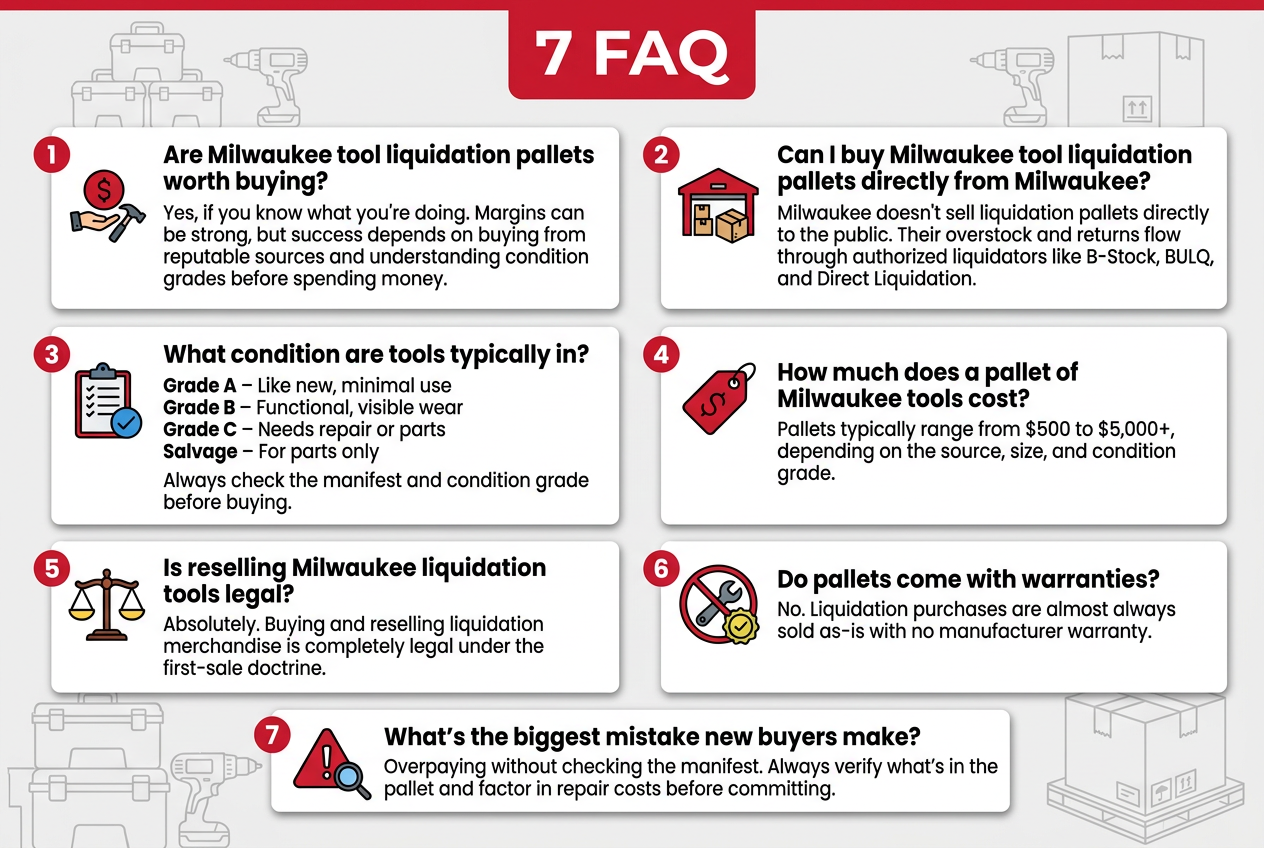
Are Milwaukee tool liquidation pallets worth buying?
Yes, if you know what you’re doing. Margins can be strong, but success depends on buying from reputable sources and understanding condition grades before spending money.
Can I buy Milwaukee tool liquidation pallets directly from Milwaukee?
Milwaukee doesn’t sell liquidation pallets directly to the public. Their overstock and returns flow through authorized liquidators like B-Stock, BULQ, and Direct Liquidation.
What condition are tools typically in?
Conditions vary widely:
Grade A – Like new, minimal use
Grade B – Functional, visible wear
Grade C – Needs repair or parts
Salvage – For parts only
Always check the manifest and condition grade before buying.
How much does a pallet of Milwaukee tools cost?
Pallets typically range from $500 to $5,000+, depending on the source, size, and condition grade.
Is reselling Milwaukee liquidation tools legal?
Absolutely. Buying and reselling liquidation merchandise is completely legal under the first-sale doctrine.
Do pallets come with warranties?
No. Liquidation purchases are almost always sold as-is with no manufacturer warranty.
What’s the biggest mistake new buyers make?
Overpaying without checking the manifest. Always verify what’s in the pallet and factor in repair costs before committing.
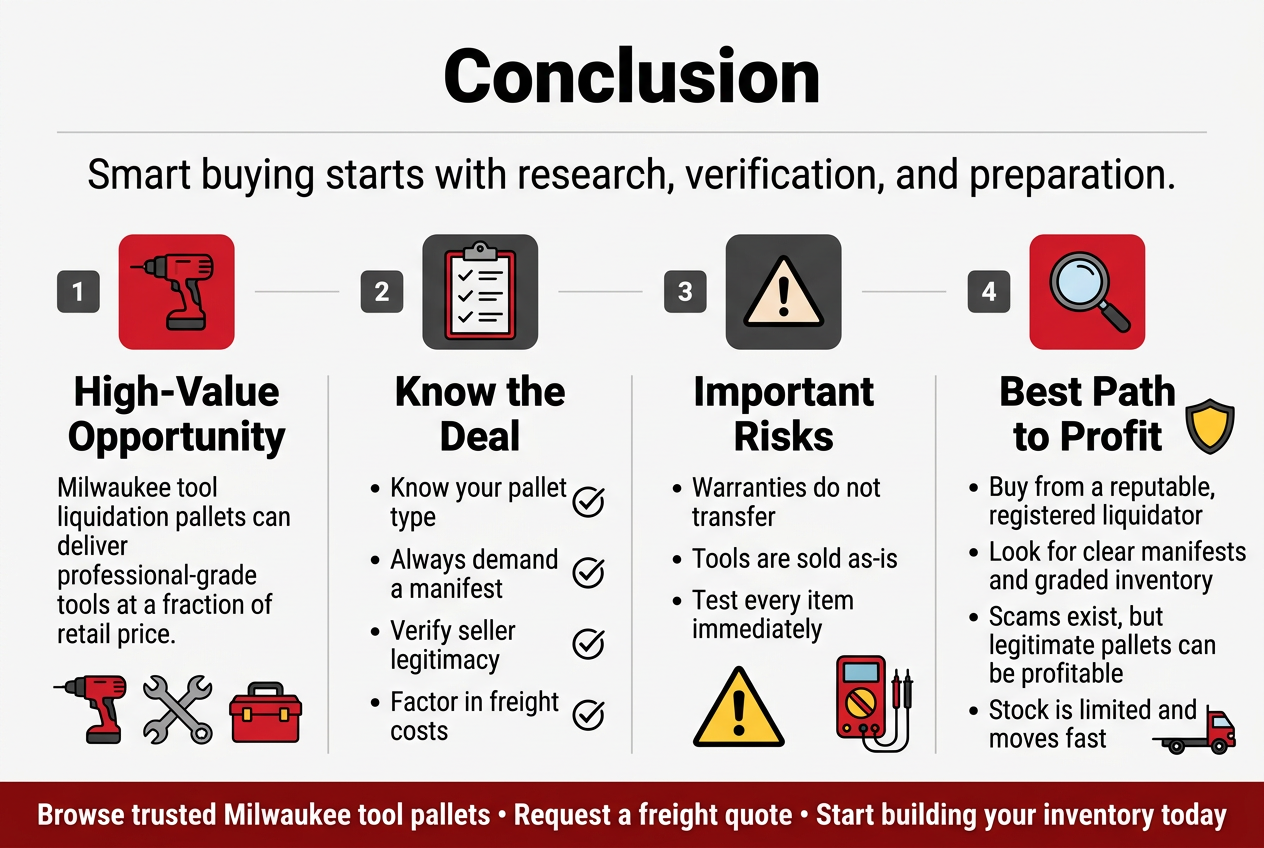
Milwaukee tool liquidation pallets offer a genuine opportunity to access high-value, professional-grade tools at a fraction of their retail price. Whether you are a reseller looking for strong margins, a contractor outfitting your crew on a budget, or a DIY enthusiast building your workshop, understanding the market is what separates a smart buy from a costly mistake. The key lessons are simple: know your pallet type, always demand a manifest, verify your seller’s legitimacy, and factor in freight costs before committing to any purchase. Remember that warranties do not transfer through liquidation channels, and tools are sold as-is, so testing every item immediately upon arrival is non-negotiable.
The liquidation market rewards those who do their homework. Scams exist, but so do legitimate, manifested pallets with real profit potential. By sourcing from a reputable, registered liquidator that provides clear manifests and graded inventory, you dramatically reduce your risk and improve your chances of a profitable outcome. If you are ready to take the next step, browse available Milwaukee tool pallets from a trusted source, request a freight quote, and start building your inventory today. Stock is limited and moves fast, so acting with confidence and preparation is your biggest advantage.