
Blog
Freight Insurance for Pallets: Coverage, Cost, and Claims


If your pallet’s invoice value tops the carrier’s liability cap, buy freight (cargo) insurance before it ships. Estimate the premium at roughly insured value times a rate benchmark of 0.1% to 2%, with most standard palletized loads landing between 0.3% and 1.0%. Then request a quote.
- Calculate your pallet’s total insured value (invoice + freight + duties)
- Request a per-shipment quote if you ship occasionally
- Ask about an annual open policy if you move pallets regularly
Quick math: A $25,000 pallet load at 0.5% runs about $125, though minimum premiums can push that higher on smaller shipments.
Key Takeaways
Freight insurance for pallets pays out based on declared value, closing the gap that carrier liability caps leave wide open on higher-value loads.
| Point | Details |
|---|---|
| Insure above carrier limits | Buy freight insurance whenever pallet invoice value exceeds carrier per-pound liability caps. |
| Choose all-risk coverage | All-risk avoids the gaps common in named-perils policies, though packaging exclusions still apply. |
| Budget 0.3% to 1.0% | Most standard pallet shipments price between 0.3% and 1.0% of insured value, plus any minimum premium. |
| Switch to annual at volume | Shippers moving 10 to 15 pallet loads a month often save by requesting an open policy quote. |
| Document everything | Pickup photos, delivery exceptions, and manifests are what separate a paid claim from a denied one. |
| Verify declared value on listings | Mega Pallets Liquidation product pages and shipping details help buyers establish accurate insured value before a pallet ships. |
This article is general information, not a substitute for advice from a qualified financial advisor. Consult a qualified financial professional about your own circumstances before acting on anything here.
Table of Contents
- What Freight Insurance for Pallets Actually Covers
- Carrier Liability Limits Leave Pallet Shippers Exposed
- How Insurance Cost Is Calculated for Palletized Freight
- Per-Shipment vs. Annual Policies for Pallet Shippers
- Filing a Claim on a Damaged or Lost Pallet
- Packaging and Security Steps That Protect Your Claim
- How Mega Pallets Liquidation Supports Insured Pallet Shipping
- The Bottom Line on Insuring Your Pallet Shipments
- Sources
What Freight Insurance for Pallets Actually Covers
Cargo insurance reimburses the shipper (not the carrier) for physical loss or damage to freight while it’s in transit, and it can extend door-to-door or apply only to specific legs of the move, depending on how the policy is written. For pallets carrying resale inventory, that scope question matters: a policy that only covers the over-the-road leg won’t help if damage happens during a warehouse transfer.
There are two main coverage forms. All-risk (often labeled ICC A in marine cargo terms) pays for any loss unless it’s specifically excluded, while named-perils coverage only pays for the specific causes listed in the policy, like fire or collision. Freightos recommends all-risk coverage for this exact reason: named-perils policies leave gaps that surface only after something goes wrong.
Even all-risk has limits. Common exclusions that trip up pallet shippers include:
- Inadequate or improper packaging
- Inherent vice (the product’s own tendency to deteriorate)
- Delay in transit
- Temperature damage without a specified cold-chain endorsement
- War, strikes, and civil commotion
Pro Tip: Read the packaging clause before you ship. Insurers routinely deny claims when pallets weren’t banded, corner-protected, or shrink-wrapped to a commercial standard, regardless of how the damage actually happened.
Carrier Liability Limits Leave Pallet Shippers Exposed
Motor carriers aren’t required to pay full replacement value when they damage or lose your freight. Liability is typically capped at a set dollar amount per pound or per package, figures written into the bill of lading and governed in interstate trucking by the Carmack Amendment. That cap protects the carrier, not you.
Here’s where it hurts on pallets specifically:
- A pallet of electronics valued at $30,000 might only recover a few thousand dollars under a per-pound carrier cap
- Bulk truckload freight often carries a released value far below actual invoice cost
- Claims against the carrier require proving negligence, which slows recovery even when the cap would otherwise apply
Freight insurance closes that gap by paying based on the pallet’s actual declared value, not a weight-based formula that was never designed to protect the cargo owner.
How Insurance Cost Is Calculated for Palletized Freight
Premium pricing follows a simple formula: insured value multiplied by rate, plus any minimum premium the insurer applies. Deductibles reduce the premium but mean you absorb the first portion of any loss.
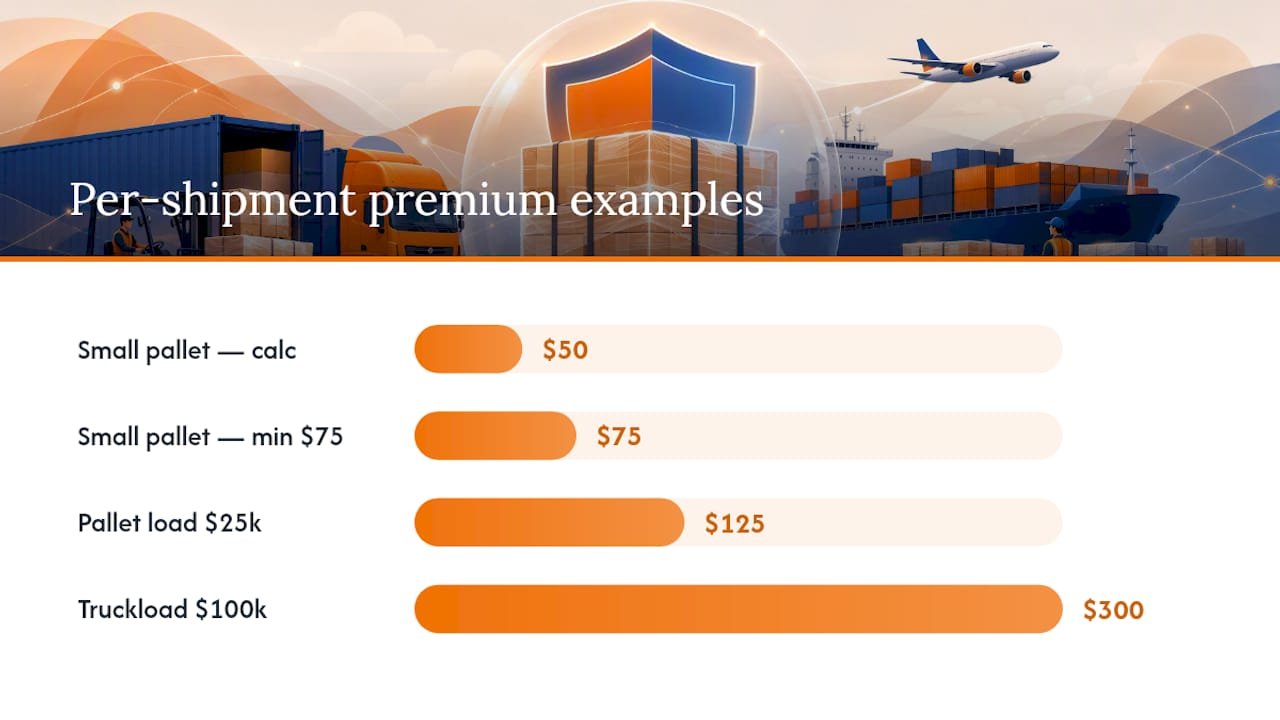
- A $5,000 pallet at a 1% rate (typical for lower-value, standard freight) costs about $50, though many insurers apply a minimum premium of $50 to $100 regardless of the calculation.
- A $25,000 pallet load at 0.5% runs roughly $125, a rate common for general merchandise on a stable lane.
- A $100,000 truckload of mixed pallets at 0.3% (a rate reserved for lower-risk commodities and consistent shippers) costs around $300.
Rate drivers include the commodity itself, the lane’s theft exposure, deductible size, and your claims history. Underwriters price electronics and other high-theft retail goods higher than commoditized freight like industrial parts, because the loss frequency data supports it. Fragile or temperature-sensitive pallets also draw higher rates, since the exposure to in-transit damage is structurally higher regardless of route.
Minimum premiums are the detail most shippers miss. On a small pallet, a $75 minimum can turn what looks like a 0.3% rate into an effective rate several times higher, which is exactly why frequent shippers should stop comparing per-shipment quotes and ask about annual pricing instead.
Per-Shipment vs. Annual Policies for Pallet Shippers
Per-shipment coverage makes sense if you ship pallets irregularly. You pay as you go, with no ongoing commitment, but that minimum premium problem hits hardest here. If you’re moving one pallet a month, you’re paying the floor rate every single time.
Annual (open) cargo policies work differently. You pay a negotiated rate across your full shipping volume for the year, and underwriters evaluate your commodity mix, lane history, and claims record to set that rate. Shippers who move consistent volume can often save 10% to 20% by switching from per-shipment coverage to an open policy once they hit a meaningful threshold.
- Shipping fewer than 5 pallet loads a month: per-shipment coverage is usually simpler and cheaper overall
- Shipping 10 to 15 loads a month or more: request an annual quote and compare it against your current per-shipment total
- Growing fast: even a rough annual estimate helps you budget before volume forces the decision
Filing a Claim on a Damaged or Lost Pallet
- Document the damage immediately. Photograph the pallet, the packaging, and any visible carrier damage before you move or unwrap anything.
- Note exceptions on the delivery receipt. If the driver won’t wait for you to inspect, write “subject to inspection” before signing.
- Keep the salvage. Don’t discard damaged goods until the insurer or their surveyor releases them.
- Gather your paperwork. Insurers typically require the commercial invoice, bill of lading, the delivery receipt showing exceptions, and a survey report for larger claims.
- Submit promptly. Late notice is one of the most common reasons claims get denied, along with missing photos and unattended-vehicle clauses that void coverage if freight was left unsecured.
Pro Tip: Take pickup photos too, not just delivery photos. A “before” record is often what separates a paid claim from a denied one when the carrier disputes when the damage occurred.
Packaging and Security Steps That Protect Your Claim
Insurers expect commercial-grade packaging, and skipping it is one of the fastest ways to void coverage. Before a pallet ships, check banding tension, corner protectors, shrink-wrap integrity, moisture barriers on sensitive goods, and even weight distribution across the pallet base.
- Inspect every pallet for damage or instability before it leaves your facility
- Use high-security seals on trailers and consider GPS tracking on higher-value loads
- Minimize transloads. Every additional handoff is another chance for damage or theft
- Vet parking locations. Unattended vehicles in unsecured lots are a common exclusion trigger
Operational controls like these are often the cheapest way to reduce both claims and premiums, since insurers reward documented, low-loss shipping histories with better rates over time.
How Mega Pallets Liquidation Supports Insured Pallet Shipping
Every product listing shows the pallet category and manifest details you need to establish a declared value, which is the number your insurer will ask for first. Our shipping and delivery page outlines what to expect at pickup so you can document pallet condition the moment it arrives.
- Photograph pallets against the invoice total before you sign for delivery
- Keep your order confirmation and manifest together as your baseline insured value
- Reference the product page description if a carrier or insurer asks what the pallet contained
The Bottom Line on Insuring Your Pallet Shipments
Buy freight insurance whenever a pallet’s value exceeds what carrier liability limits would actually pay out. That’s the whole decision, and for most resale inventory, it’s not close.
- Calculate insured value as invoice cost plus freight and any duties
- Request 2 to 3 quotes and compare minimum premiums and deductibles side by side, not just the headline rate
- Photograph pallet condition at pickup and get any damage noted on the delivery receipt before the driver leaves
Skipping this step doesn’t save money. It just moves the risk from an insurer’s balance sheet to yours.
A Practical Take on Deductibles and Small Pallets
Self-insuring makes sense for low-value pallets where the premium and deductible would eat most of the potential payout anyway. Above a few thousand dollars, though, the math flips fast. One habit worth building regardless: photograph every pallet at pickup and store those photos somewhere you’ll actually find them later.
— Nene
Where Mega Pallets Liquidation Fits Into Your Insurance Plan
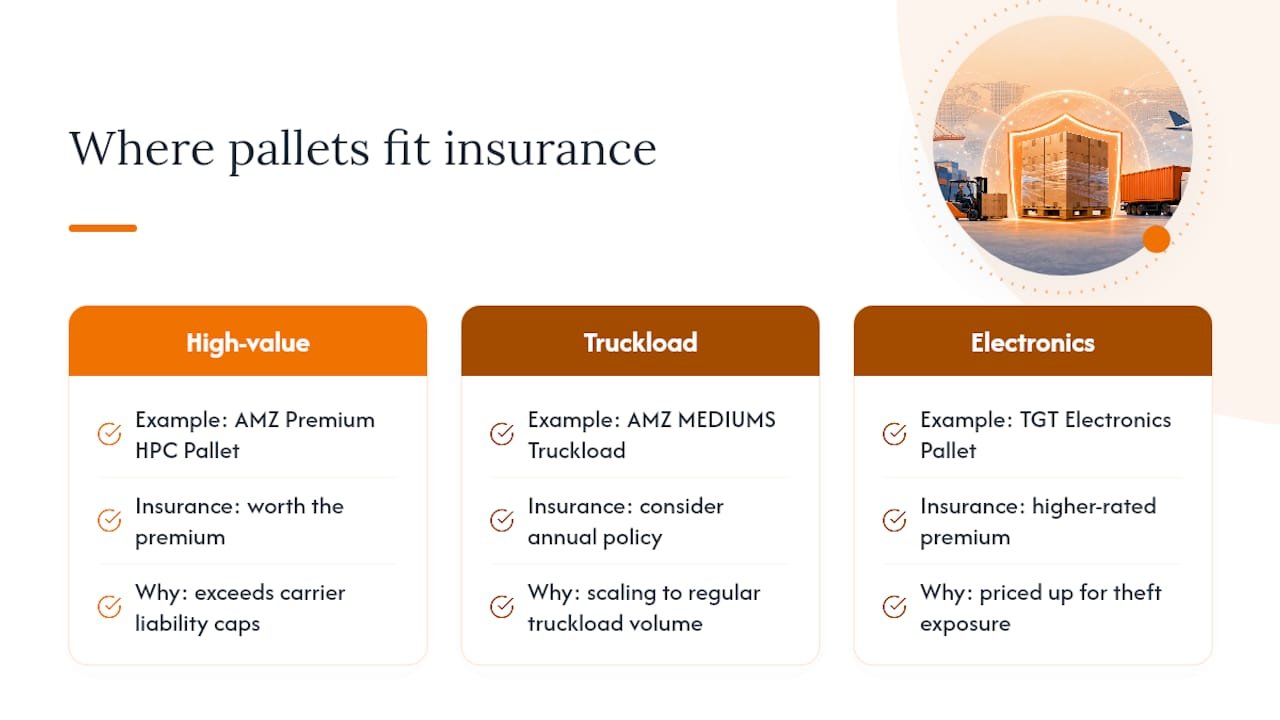
Once you know what freight insurance costs, the next question is what you’re actually insuring. That’s where your inventory choice matters. The AMZ Premium HPC Pallet is a good example of higher-value inventory that typically exceeds standard carrier liability caps, making insurance worth the premium. If you’re scaling toward regular truckload volume, the AMZ MEDIUMS Truckload listing shows the kind of bulk purchase that can justify shopping an annual policy instead of paying per-shipment minimums every time.
Electronics carry their own rating logic. Our TGT Electronics Pallet listing reflects a commodity category insurers price higher because of theft exposure, so factor that into your premium estimate before you buy.
Every product page lists the manifest details you’ll need to declare value accurately, and our shipping and delivery page walks through what to check at pickup. Browse current inventory on Mega Pallets Liquidation and request your shipping details before your next pallet order ships.