Blog
Pallet Flipping Business: A Beginner’s Guide to Getting Started


Pallet Flipping Business models can be highly profitable, but the model operates more like a hands-on reselling hustle with strong margins than passive income. Success in a pallet flipping business depends on three core practices: analyzing the itemized manifest before bidding, controlling your freight costs, and maintaining a repeatable testing and listing process.
Before spending your first dollar on inventory, complete these three foundational steps:
Set a firm budget: Establish a conservative, all-in budget (typically $300 – $750 for a single general merchandise starter pallet) that you will not exceed under any circumstances.
Confirm pickup vs. freight: Determine whether local warehouse pickup or LTL (Less-Than-Truckload) freight delivery makes the most financial sense for your first shipment before placing a bid.
Build a reselling tracking sheet: Create a detailed spreadsheet to track buy cost, expected yield, platform selling fees, labor time, and resale value before committing capital.
Pro Tip: Don’t buy your first liquidation lot until your spreadsheet is fully built. If you can’t model the math on paper, you cannot accurately judge a competitive bid.
Key Takeaways
A profitable pallet flipping business relies on capping your maximum bid using manifest calculations.
Controlling transportation costs and factoring in freight options prevents hidden delivery charges from destroying your profit margin.
Treating a realistic unsellable/damaged item write-off rate (typically 10% – 20%) as a standard cost of doing business ensures accurate revenue projections.
| Point | Details |
|---|---|
| Cap your bid before buying | Use manifest value, expected yield, fees, and labor to calculate a max bid, not a hopeful one. |
| Budget for write-offs | Plan for 10 to 50 percent in unsellable stock depending on lot type, and treat it as normal. |
| Match channel to item type | Sell bulky goods locally and tested electronics or branded items on eBay or Amazon. |
| Start with lower-risk categories | Mega Pallets Liquidation’s general merchandise and mixed electronics pallets suit beginners testing their first spreadsheet-based buy. |
Where to Source a Pallet for Your Flipping Business
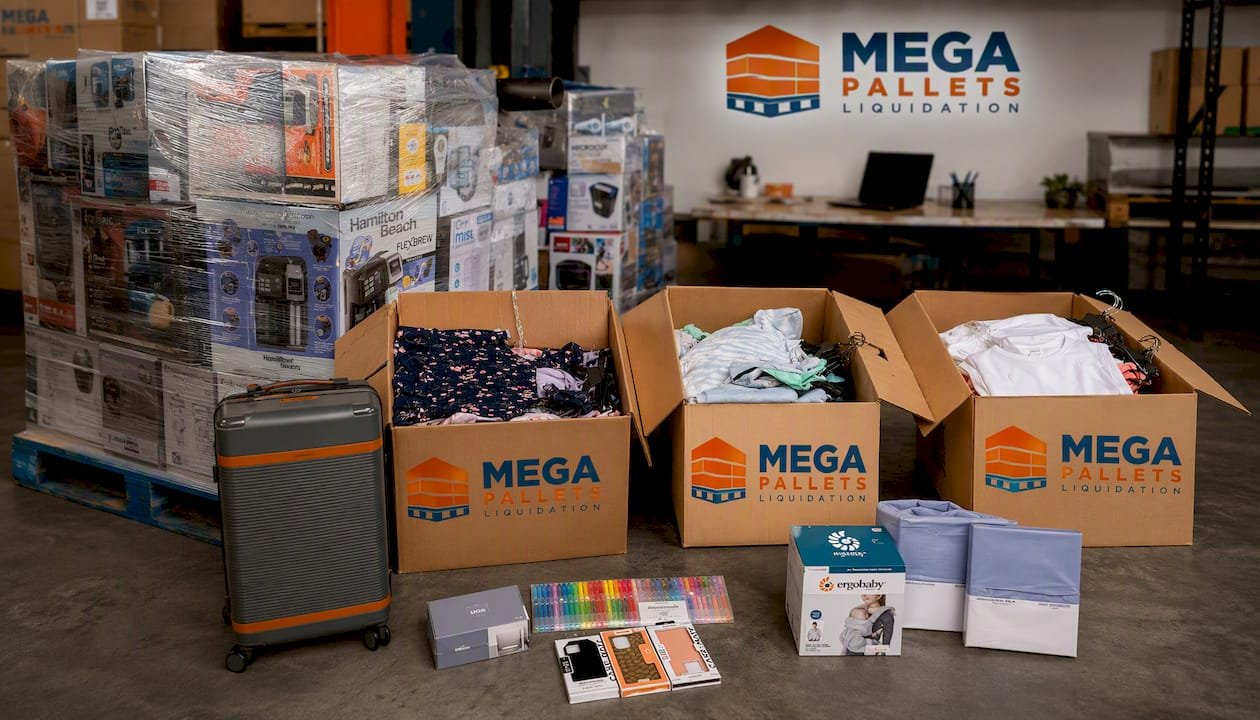
Not every sourcing channel deserves your first dollar. Retailer liquidation programs, third-party marketplaces, local liquidators, and Facebook groups all sell pallets, but they carry different risk levels for someone still learning how to read a manifest.
- Retailer liquidation programs — Direct-from-retailer lots often include the clearest paperwork, but minimum order sizes can be steep for a first buy.
- Third-party liquidation marketplaces — Convenient and searchable, though quality varies wildly by seller reputation.
- Local liquidators — You can inspect pallets in person before paying, which beginners should prioritize over blind online buys, according to Side Hustle Nation’s pallet flipping breakdown.
- Facebook groups and local classifieds — Good for building supplier relationships, but quality control depends entirely on the seller’s honesty.
For pallet types, overstock and shelf-pull pallets carry lower risk than customer-return pallets because the merchandise hasn’t been opened, tested, or damaged by a previous owner. Save mixed customer-return lots for after you’ve processed a few easier pallets.
Three non-negotiable buying rules: demand the manifest before bidding, cap your price using the formula in the next section, and skip blind “as-is” lots until you have a few successful pallets behind you.
How Do You Read a Manifest and Set a Max Bid?
A manifest lists the retail value of everything in the pallet, but retail value and resale value are two very different numbers. Realized resale on return pallets typically lands around 30 to 40 percent of manifest value, while overstock and shelf-pull pallets tend to perform better since the items are new and untested.
Your max bid formula needs five inputs:
- Manifest value (the retail total listed)
- Expected resale yield (use 30 to 40 percent for returns, higher for overstock)
- Marketplace fees (typically 10 to 15 percent per platform)
- Processing labor, valued at an hourly rate you assign yourself
- Freight and disposal costs for unsellable items
Here’s a working example. A pallet manifests at $2,000. At a 35 percent yield, expected resale is $700. Subtract $90 in marketplace fees, $60 in packing materials, and $50 in freight, leaving $500. If you want a 40 percent margin buffer before labor, your max bid lands near $300, not the $500 that feels tempting on paper.
Should You Pick Up Your Pallet or Ship It LTL?
How Should You Handle Pickup and Freight in a Pallet Flipping Business?
In a Pallet Flipping Business, local pickup usually beats LTL freight for your first few pallets. It’s faster, lets you inspect the load before it leaves the lot, and skips the accessorial fees that can quietly wreck margins on freight shipments.
Choose pickup when the source is within driving distance — you save on freight and can catch damage issues immediately, which is especially important when starting a Pallet Flipping Business.
Choose LTL only after getting a firm quote — freight and accessorials often become the single largest variable cost in a pallet deal, sometimes running from $100 to several hundred dollars.
Ask about liftgate fees, residential delivery charges, and limited-access fees before confirming any freight booking. Keeping these costs under control is essential for protecting Pallet Flipping Business margins.
Inspect immediately on arrival — photograph pallet condition, count boxes against the manifest, and flag shortages before you sign for delivery. This simple habit can protect your Pallet Flipping Business from avoidable supplier disputes.
Skipping that last step is how sellers lose disputes with their supplier later.
What’s the Fastest Way to Process a Pallet for Resale?
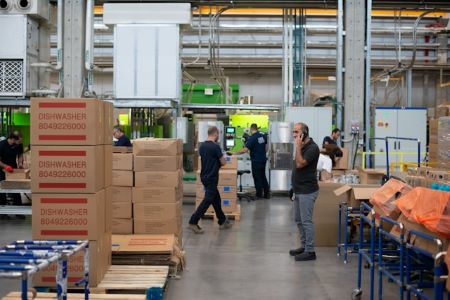
Speed comes from batching, not rushing. A successful Pallet Flipping Business should use a repeatable workflow: unpack everything first, sort into categories, then move through testing, cleaning, labeling, photographing, and listing in dedicated passes rather than handling one item start to finish before moving to the next.
- Unpack and sort by category (electronics, apparel, general goods) before touching anything else.
- Test electronics in batches using a simple pass/fail log; note the SKU, condition, and expected sale price.
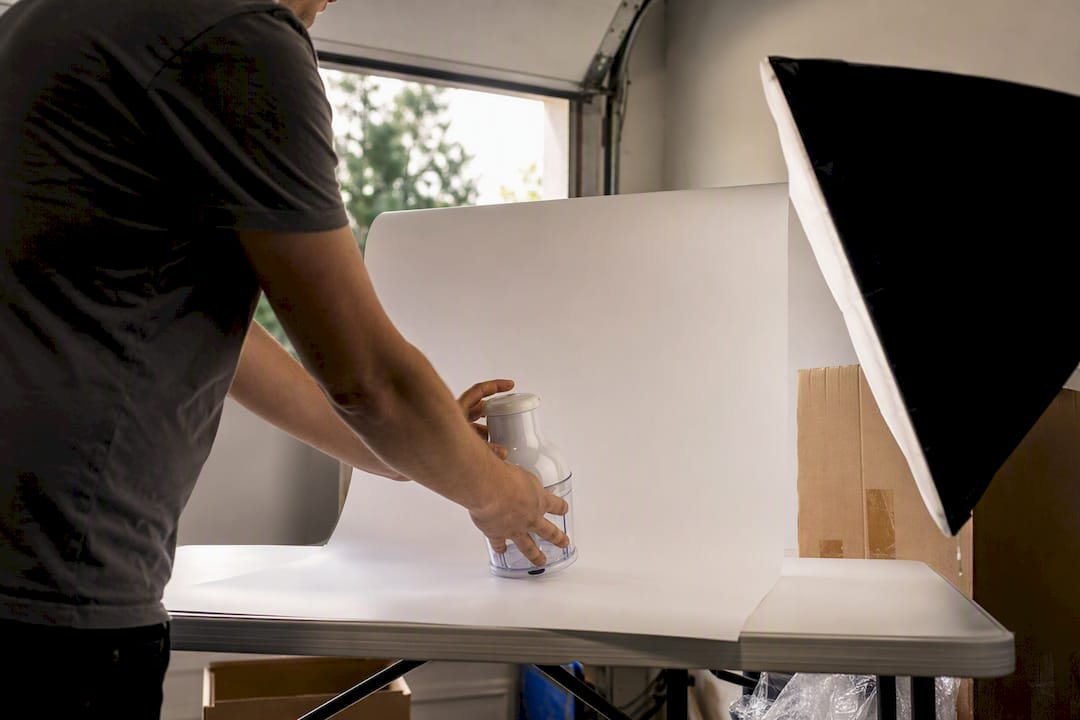
- Photograph items against a consistent background so listings go faster later.
- Pre-write listing templates for common categories to avoid rewriting descriptions from scratch.
- Bundle low-value, low-margin SKUs into lots instead of listing them individually to cut per-item shipping costs.
Beginners should plan for roughly 1 to 50 hours of processing time per pallet, depending on category complexity and pallet size. Books and general merchandise move faster than mixed electronics that need functional testing. Efficient processing can make a major difference to the profitability of a Pallet Flipping Business.
Pro Tip: Standardize your photo setup once, and every future listing takes half the time.
Which Sales Channel Fits Each Type of Item?
Not every item belongs on the same platform. Matching the channel to the item protects your margin far more than chasing the highest possible listing price. For anyone building a Pallet Flipping Business, choosing the right sales channel can make the difference between slow-moving inventory and consistent turnover.
- Bulky or heavy items: Furniture and appliances often sell best through local pickup on Facebook Marketplace or OfferUp, since shipping costs can erase profit.
- Tested electronics and name-brand goods: These can perform well on eBay or Amazon, where buyers may pay more for verified condition.
- Low-value or damaged-box items: Bundle them into lots sold locally rather than listing them individually.
- Apparel and shoes: These often work well on resale-specific apps where buyers already expect secondhand pricing.
Check completed listings, not active ones, to set realistic pricing bands by condition. An item listed at $40 means little if it never sold; an item that sold at $28 tells you what buyers actually paid. This approach helps a Pallet Flipping Business price inventory based on real market demand instead of guesswork.
What Does a Real Pallet Flipping Business Profit Calculation Look Like?
Every pallet carries the same six cost categories, whether it’s a $300 test buy or a $2,000 bulk order: purchase price, inbound freight, processing labor, packing materials, marketplace fees, and disposal for unsellable items.
- Purchase price: The winning bid or listed price, ideally capped using your manifest math.
- Inbound freight: Pickup mileage cost or LTL freight plus accessorials.
- Processing labor: Hours spent testing, cleaning, and listing, valued at your own hourly rate.
- Packing and outbound shipping: Materials plus per-item shipping cost, which varies enormously by item size.
- Marketplace fees: Typically 10% to 15% of sale price depending on the platform.
- Disposal: Cost to donate or discard unsellable units.
Experienced flippers budget a write-off rate of 10% to 50% depending on lot type, treating that loss as a normal cost rather than a surprise. Returns pallets sit at the higher end of that range; overstock sits lower. Building these assumptions into your numbers helps keep a Pallet Flipping Business financially realistic.
Here’s a sample calculation. A $500 general merchandise pallet with a $2,000 manifest realizes 35% yield, or $700 in gross resale. Freight runs $60, packing $40, marketplace fees $80, and a 20% write-off removes roughly $140 in unsellable stock value from the equation. Net profit lands near $80 to $100 on that pallet, a modest but real return once labor hours are also factored against your target hourly rate.
That’s a realistic first-pallet outcome, not a windfall. For a Pallet Flipping Business, the goal should be to understand the numbers, improve sourcing and processing efficiency, and gradually increase profitable inventory turnover rather than assuming every pallet will produce a huge return.
What Mistakes Sink a New Pallet Flipper?
Most losses trace back to three habits: overbidding past a calculated max bid, ignoring freight until after the sale, and buying pallets with no manifest at all.
- Overbidding — Set your max bid before you see the auction, and walk away when it’s exceeded.
- Skipping freight quotes — Get a firm number before bidding, never after.
- Buying blind lots without a manifest — Manifest access substantially lowers risk; treat no-manifest pallets as low-stakes learning purchases only.
- Ignoring supplier red flags — Vague manifests, refusal to answer questions, or pressure to bid immediately are reasons to walk away.
Start with a small pallet, keep a donation or disposal plan ready for dead stock, and treat your first few purchases as tuition.
How Mega Pallets Liquidation Lowers Your Sourcing Risk
Beginners do best starting with categories that carry lower testing risk and clearer manifests. General merchandise pallets fit that need, since items typically require less inspection than electronics.
- Organized, category-based inventory instead of unsorted blind lots.
- Nationwide shipping with stated options, so freight cost is knowable before you order.
- Reseller-focused guidance pages, including common resale mistakes to avoid.
- A published ordering process that spells out what happens after checkout.
Before ordering, check manifest availability, shipping cost, and return policy on the product page itself.
How Do You Check a Pallet’s Condition Before You Buy It?
Quality control starts before the pallet ever ships, not after it arrives. If a seller won’t answer basic condition questions, that’s your first signal to walk away.
Ask for photos of the actual pallet, not stock images, whenever a seller offers them. Request the manifest and read it line by line, checking for vague category descriptions like “assorted electronics” that hide low-value filler stock. Ask specifically whether the lot is customer returns, shelf-pull, or overstock, since each carries a different realistic condition range.
For in-person inspections at local liquidators, check for water damage on boxes, torn packaging, and mismatched labels that suggest re-boxed or previously returned merchandise. Weigh or estimate the pallet’s total unit count against the manifest; a significant shortfall is a red flag before you even open a box.
Once the pallet arrives, your receiving inspection becomes your second layer of quality control. Photograph the pallet as it sits on your dock or in your garage before touching it, count boxes against the manifest, and flag any visible damage immediately with the shipping carrier or seller. Open a sample of boxes across different sections of the pallet rather than just the top layer, since sellers sometimes place their best items where buyers look first.
Keep a simple test log for electronics and anything with moving parts. Mark each unit as sellable, repairable, or write-off, and total those categories at the end. That log becomes your real yield percentage for that pallet, and comparing it across multiple pallets from the same supplier tells you whether that source is worth repeating.
How Long Does It Take to Go From Purchase to Profit?
A realistic first-pallet timeline runs about two to four weeks from purchase to fully realized profit, assuming you’re working it as a side hustle rather than full time.
Week one covers sourcing and the purchase itself: requesting manifests, calculating your max bid, confirming freight or pickup, and closing the deal. Week two is receiving and processing, where most of your labor hours land. Plan for 1 to 50 hours of processing time depending on pallet size and category complexity, spread across evenings or weekends.
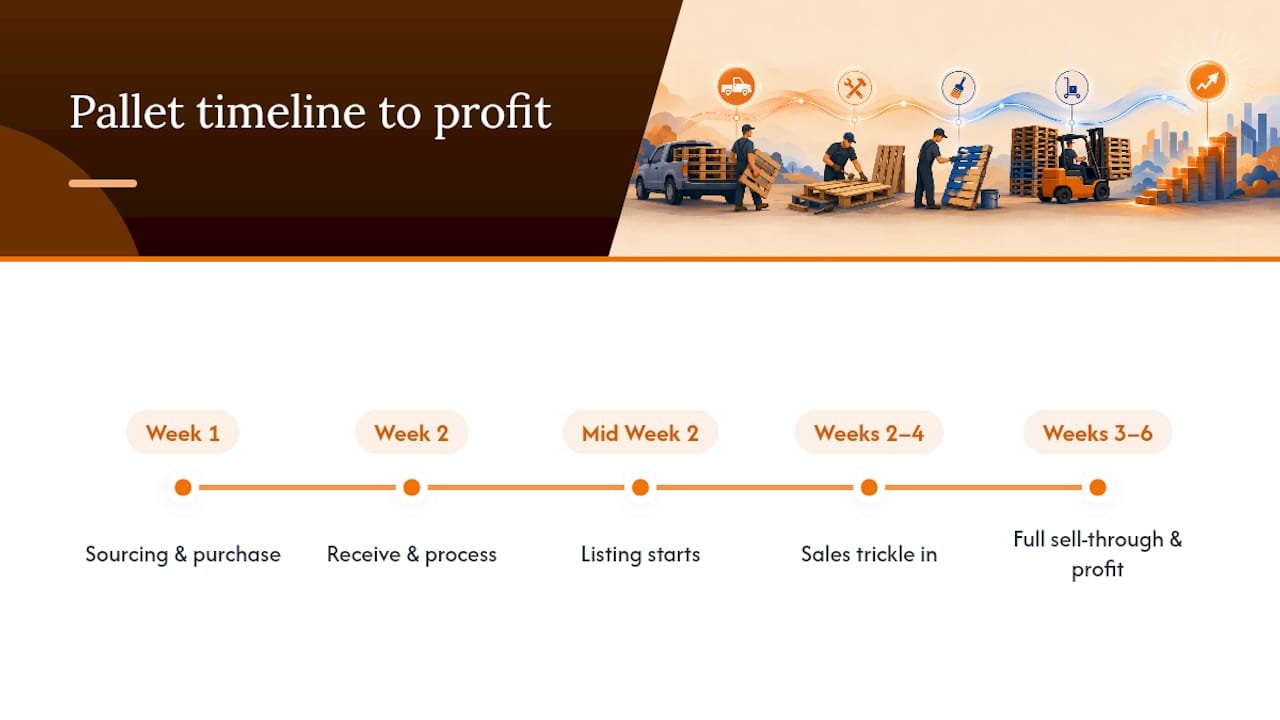
Listing typically starts partway through week two, once the first batch of tested items is photographed and priced. For a Pallet Flipping Business, sales usually trickle in over the following two weeks; bulky local-pickup items often move within days, while niche electronics or apparel can take longer to find the right buyer. Full sell-through on a pallet, meaning every sellable unit has moved, commonly takes three to six weeks depending on how aggressively you price and how many channels you’re using.
Profit realization isn’t a single moment in a Pallet Flipping Business. You’ll likely break even on your buy cost within the first two weeks of sales, with the remaining margin trickling in as slower-moving items finally sell. This is why cash flow planning matters: don’t commit your next pallet’s budget until you’ve actually collected payment from the current one, not just listed the items.
Tracking time-to-sell by category over your first three or four pallets gives your Pallet Flipping Business real data on which item types tie up your cash longest. That information should directly influence which categories you prioritize sourcing going forward.
Do You Need a Business License to Flip Pallets?
Requirements vary by state and city, but most pallet flippers operating beyond occasional garage-sale volume need to register as a business and collect sales tax where required. Sole proprietorships are the simplest starting structure, letting you operate under your own name without formal incorporation, though many sellers eventually form an LLC once volume grows, mainly for liability protection.
For a growing Pallet Flipping Business, understanding your local registration and tax requirements is important before your sales volume increases.
Sales tax obligations depend on where you’re selling and through which channel. Marketplaces like eBay and Amazon often collect and remit sales tax automatically on your behalf under marketplace facilitator laws, but local pickup sales through Facebook Marketplace typically don’t include that automatic collection, meaning you may owe the tax yourself depending on your state’s rules.
Reseller permits, sometimes called resale certificates, let you buy inventory without paying sales tax at purchase since you’ll collect it from the end buyer instead. Most states issue these free or for a small fee through the state’s department of revenue, and liquidation suppliers will often ask for one before extending business pricing.
Income from a Pallet Flipping Business is taxable regardless of business structure, and the IRS treats consistent resale activity as a business rather than a hobby once it shows a profit motive and regular activity. Keep receipts for every purchase, freight cost, and supply expense, since those are legitimate deductions against your resale income.
None of this requires a lawyer to start. A simple sole proprietorship, a resale certificate from your state, and a basic spreadsheet for income and expenses can cover many beginners through their first year. Always verify current requirements with your state and local tax authorities before starting or expanding your Pallet Flipping Business.
How Do You Market Pallet Flipping Inventory Effectively?
Good marketing for resale inventory comes down to clear photos, honest condition descriptions, and pricing that matches what similar items actually sold for, not what you wish they’d sell for.
Photograph every item against a clean, consistent background with good lighting, since blurry or dark photos are the single fastest way to lose a buyer’s attention on a crowded marketplace page. Write condition descriptions that state exactly what you tested and found, including minor cosmetic flaws, since transparency reduces returns and negative feedback more than any clever sales copy.
Cross-post the same item across multiple channels when the platform allows it, giving bulky local items visibility on both Facebook Marketplace and OfferUp simultaneously. For niche categories, joining relevant Facebook buy-and-sell groups or local collector communities can move specialty items faster than a general marketplace listing ever will.
Bundling underperforms individually priced items when it comes to slow-moving small goods; a “lot of 10 assorted phone cases” often sells faster than ten separate $2 listings that buyers scroll past. Building a small base of repeat local buyers, especially for bulky items, also cuts your marketing effort over time since word-of-mouth referrals start replacing cold outreach. If you’re selling niche retail categories, browsing how established retailers position product assortments for resale audiences can offer useful merchandising ideas beyond generic listing tips.
How Do You Scale Beyond Your First Few Pallets?
Scaling a pallet flipping operation works best as a gradual process tied to proven numbers, not enthusiasm. Before buying your second or third pallet, confirm that your first pallet actually hit your target return on investment once all costs, including your own labor hours, were accounted for.
Once you have two or three pallets with consistent, repeatable ROI, the next constraint usually becomes storage space rather than capital. Garages and spare rooms work for one pallet at a time, but sustained operations at volume typically require a dedicated storage unit or small warehouse space, which adds a fixed monthly cost that needs to be factored into your margin math going forward.
Labor becomes the next bottleneck. A solo seller processing 1 to 50 hours per pallet can realistically handle a handful of pallets per month alongside other work. Scaling past that point means either bringing on part-time help for unpacking and photography, or narrowing your focus to categories you can process fastest, since specialization improves per-hour economics far more than volume alone.
Diversifying suppliers matters as you scale, since relying on a single source exposes your entire operation to that source’s quality inconsistency. Building relationships with two or three reliable sources, including a curated supplier for higher-value categories, spreads that risk. As margins on common SKUs compress from increased competition in the space, sellers who scale successfully tend to specialize in categories or local channels where they’ve built genuine buyer relationships, rather than competing purely on price against every other reseller flipping the same generic merchandise.
What I’d Actually Test Before Calling This a Business
Buy one pallet under a strict all-in cap, no higher than your calculated max bid, and give yourself two weeks to fully process it. Track four numbers: the percentage of units that turned out sellable, total hours spent per pallet, net ROI after every cost including labor, and time-to-sell for the last unit.
Don’t scale until that first pallet clears a real return, not a hopeful one, and until you have storage space for the next batch. If the numbers don’t work on pallet one, they won’t magically improve on pallet five just because you bought more volume.
— Nene
Where to Buy Your First Pallet Without the Guesswork
Megapalletsliquidation gives you what a random online auction can’t: organized categories with clearer manifests, so you’re not gambling on a blind lot for your first purchase. That’s the real advantage over sourcing cold through unfamiliar third-party sellers.
Start by browsing general merchandise pallets if you want the lowest-risk entry point, since these lots typically involve less testing than electronics. If you can already test and grade tested devices, mixed electronics pallets offer stronger margins for buyers ready for that step up. Once you’ve run the math and want a higher-value, brand-name-first option, Premium Nordstrom pallets are built for resellers targeting a more premium resale audience.
Before you order, check the manifest, confirm your shipping option, and review the return policy listed on the product page. Reach out through Mega Pallets Liquidation’s support team if anything about a listing needs clarifying, then place your first order and start your two-week test.
Sources
- Pallet Flipping for Beginners: Manifest Math Before You Bid
- I started flipping Amazon pallets to earn extra income, and now I run a multimillion-dollar e-commerce business
- Pallet Flipping: How We Made $25k Flipping Liquidation Pallets