
Blog
Resellers’ Pallet Manifest Examples: Copyable Template, Publisher View


A pallet manifest is the itemized list of contents tied to a specific pallet, showing what’s inside by SKU, quantity, and often condition, so buyers can judge value before money changes hands. Compare that to a blind or unmanifested pallet, where you’re buying based on category alone. Below are real manifest layouts, a copyable template, and the exact fields that separate a profitable pallet from an expensive gamble.
TL;DR:
- Most manifests list SKU and condition details, but vague descriptions and missing condition legends indicate higher risk.
- Values are often inflated with MSRP totals, so buyers should estimate actual resale value based on recent market prices rather than MSRP.
- Be cautious of pallets with high salvage or parts-only lines, as they significantly lower recovery rates and profit potential.
- Restricted brands, hazmat items, or un flagged battery content require extra compliance checks before reselling or shipping.
- Always verify unit counts, freight costs, and condition codes, and compare your own estimated recovery to the asking price to determine a fair bid.
Table of Contents
- What Pallet Manifest Examples Reveal About Manifested vs. Unmanifested Pallets
- Reading the Manifest Columns: SKU, Condition, MSRP, and Weight
- How to Read a Pallet Manifest Before You Buy
- Manifest Red Flags That Signal a Bad Pallet
- Sample Pallet Manifest Layouts You Can Copy
- Legal and Compliance Considerations Related to Pallet Manifests
- How Manifests Connect to Your Inventory and Warehouse Systems
- Keeping Pallet Manifests Accurate as Inventory Moves
- Auditing a Manifest and Resolving Discrepancies With the Seller
- Publisher Perspective: How Mega Pallets Liquidation Approaches Manifests
- Where to View Manifested Pallets and Buy With Confidence
- Sources
- FAQ
What Pallet Manifest Examples Reveal About Manifested vs. Unmanifested Pallets
A pallet manifest works like an itemized packing list. It shows product descriptions, quantities, and typically an estimated retail value tied to a specific pallet ID, so a buyer can estimate contents and product mix before paying for it. That’s different from a bill of lading, which covers shipping logistics like carrier, weight, and delivery terms rather than what’s actually packed inside the boxes.
The manifested-versus-unmanifested split is the first decision every reseller makes:
- Manifested pallets list SKUs, quantities, and condition notes, which lowers your risk because you know roughly what you’re buying.
- Unmanifested (blind) pallets ship with no itemized list, priced lower to reflect that uncertainty, with occasional upside for buyers willing to gamble.
- Partial or manufacturer-specific manifests cover only some SKUs on the pallet, common with mixed-return loads, and should be priced as if the unlisted portion is unmanifested.
Treat any manifest missing a legend or condition key the same way you’d treat a blind pallet: cautiously.
Reading the Manifest Columns: SKU, Condition, MSRP, and Weight
Most manifests share a common column structure, even though formatting varies by seller. Learning to scan these fields in order takes less than a minute per pallet once you know what you’re looking for.
- Line number and SKU/UPC/ASIN identify the exact product. Cross-check the UPC against GS1 barcode standards if a description looks generic or mismatched.
- Description tells you what the item is in plain language, but treat vague entries (“assorted home goods”) as a red flag rather than a category.
- Quantity per line and unit of measure (UOM) matter because a line reading “2 CS” of a case-packed item might mean 48 total eaches, not two units.
- MSRP or estimated retail value is almost always inflated. Sellers total manifest MSRP to make a pallet look bigger than its actual resale value.
- Condition code tells you whether an item is new, like new, damaged, or salvage. This is the single column that determines your real margin.
- Pallet ID, gross weight, and dimensions determine freight cost and whether the load fits your storage or a standard 48×40 footprint.
- Special flags for hazmat, lithium batteries, or restricted brands change how (and whether) you can legally resell the item.
Pro Tip: Never value a pallet off the MSRP total. Build your own per-line estimate using recent sold prices on marketplaces, then compare that number to the asking price.
How to Read a Pallet Manifest Before You Buy
A repeatable reading order, moving from identifiers to condition to logistics, keeps you from missing the detail that actually changes your offer.
- Confirm units first. Multiply case quantities by units-per-case to get total eaches. A manifest listing “12 CS” of a 24-pack item means 288 units, not 12.
- Check lane value, not MSRP. Search the UPC or SKU on resale marketplaces to see what similar items actually sell for in your channel. MSRP tells you what the item costs new; it doesn’t tell you what buyers will pay you.
- Map condition codes to recovery rates. New or like-new items might recover 40 to 60 percent of retail; salvage or parts-only lines often recover far less once labor and testing time are factored in.
- Flag restricted or hazmat items early. Lithium batteries, medical devices, and certain brand-restricted goods (cosmetics, electronics with brand-protection policies) complicate resale and shipping. Check PHMSA guidance before assuming any battery-containing item ships the same way as a t-shirt.
- Factor freight into delivered cost. Weight and dimensions determine shipping cost per pallet, and that number needs to be added to your purchase price before you calculate margin.
- Set a maximum bid and decide on inspection. Once you’ve built a line-by-line estimate, set your ceiling price and decide whether you need photos or a sample inspection before committing.
Pro Tip: Keep a running spreadsheet of recovery rates by condition code and category. After ten or so pallets, your own historical data will be more accurate than any generic recovery percentage.
Manifest Red Flags That Signal a Bad Pallet
Certain patterns show up again and again on manifests that underperform, and experienced buyers learn to spot them fast.
- Vague, repeated descriptions (“general merchandise,” “misc electronics”) without SKU-level detail suggest the seller doesn’t have granular data, or is hiding something.
- Inflated MSRP totals relative to the asking price are a marketing tactic, not a value signal.
- A high share of “salvage,” “parts only,” or “mixed returns” lines drags down your blended recovery rate fast, even if a few lines look strong.
- No condition-code legend means you’re guessing at what “B” or “3” actually means, and there’s no industry-standard definition for these codes; every seller sets its own.
- Inconsistent units of measure across lines (some in cases, some in eaches, with no clear labeling) usually signal a manifest assembled carelessly.
- Restricted-brand or hazmat items buried in a general merchandise pallet can turn a cheap load into a compliance headache.
When you see two or more of these on a single manifest, price the pallet as if it were unmanifested and discount your offer accordingly. A pallet listing 30 percent of lines as “customer return, condition unknown” should be valued closer to salvage rates across the board, not blended with the new-condition lines at face value.
Sample Pallet Manifest Layouts You Can Copy
Here’s what a SKU-level manifest looks like when a seller does it right. This example uses realistic categories rather than real seller data, but the structure mirrors what you’ll see on manifested pallet listings.
A category-level manifest looks different. Instead of line-by-line SKUs, it groups items by type and gives you an estimated count and blended condition, which means you’ll need to build in a wider margin of error when pricing your offer.
To build your own tracking sheet, start with these columns: Pallet ID, SKU, Description, Qty, UOM, Condition Code, MSRP, Cost-per-Each, Estimated Recovery, Weight, Dimensions, Flags. Compute cost-per-each by dividing the pallet’s purchase price by total eaches, then compare that number line by line against estimated recovery to find your margin. For freight planning, a pallet load calculator converts manifest quantities into cartons-per-layer and total stack height against a standard 48×40 footprint, which matters if you’re stacking multiple pallets in a truck or storage unit.
Legal and Compliance Considerations Related to Pallet Manifests
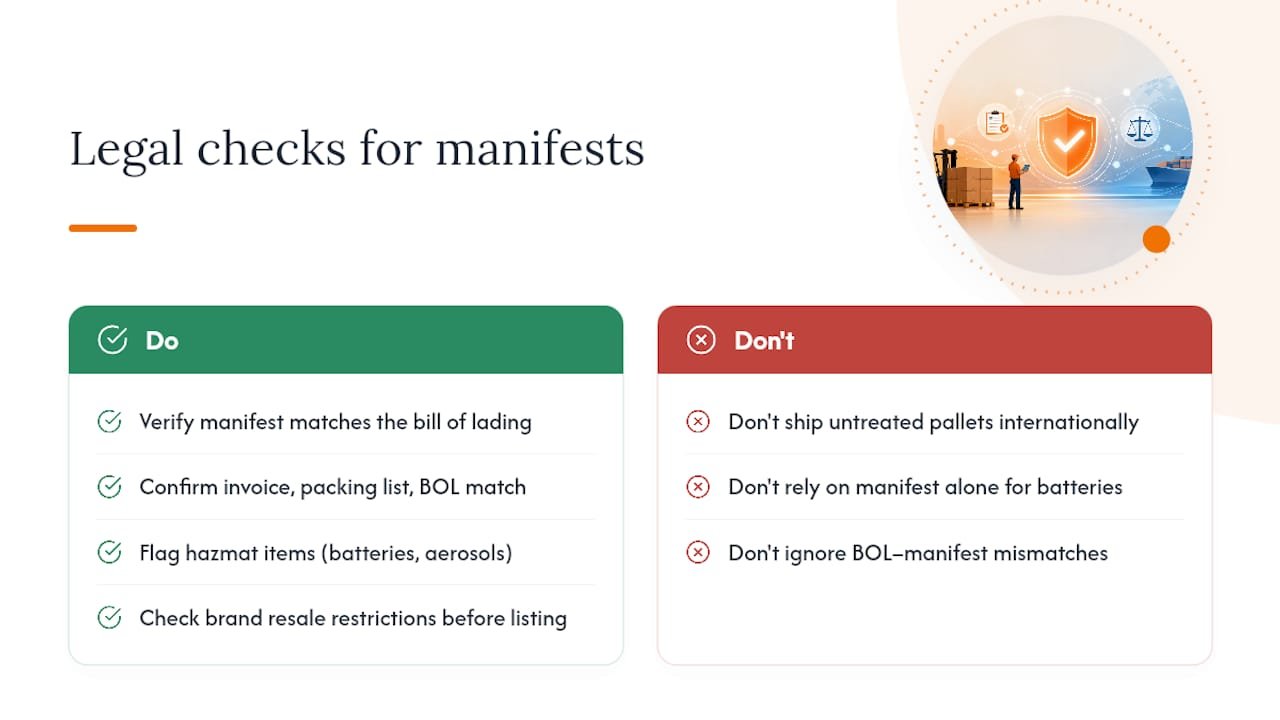
Manifest accuracy isn’t just a valuation issue. Federal rules require for-hire carriers to issue a bill of lading listing shipper, receiver, item descriptions, package counts, and weight, and mismatches between the manifest and the BOL can cause delivery delays or complicate cargo claims if something goes missing in transit.
If your pallet crosses a border, additional documentation applies. Wood pallets used in international shipments need to meet ISPM 15 treatment standards, and customs clearance typically relies on a three-way match between the commercial invoice, packing list, and bill of lading. A manifest that doesn’t line up with those documents can hold a shipment at the border.
Hazmat items deserve their own scrutiny. Lithium batteries, aerosols, and certain chemical-based products fall under PHMSA regulations for ground shipping, which cover labeling, packaging, and carrier notification requirements. If a manifest lists electronics or cosmetics without flagging battery content, don’t assume compliance. Confirm it yourself before you resell.
Restricted-brand items add another layer. Some manufacturers limit where their products can be resold, and a manifest won’t always flag brand-restriction issues. Resellers moving items through marketplaces with brand-gating policies should check restrictions before listing, not after receiving a takedown notice. None of this requires a legal team to manage, but it does require reading past the SKU and price columns into the fine print most buyers skip.
How Manifests Connect to Your Inventory and Warehouse Systems
A manifest is only useful once its data moves into a system you can actually search, sort, and report from. Most resellers start by importing manifest lines into a spreadsheet, then graduate to inventory software once volume grows past what a spreadsheet can track cleanly.
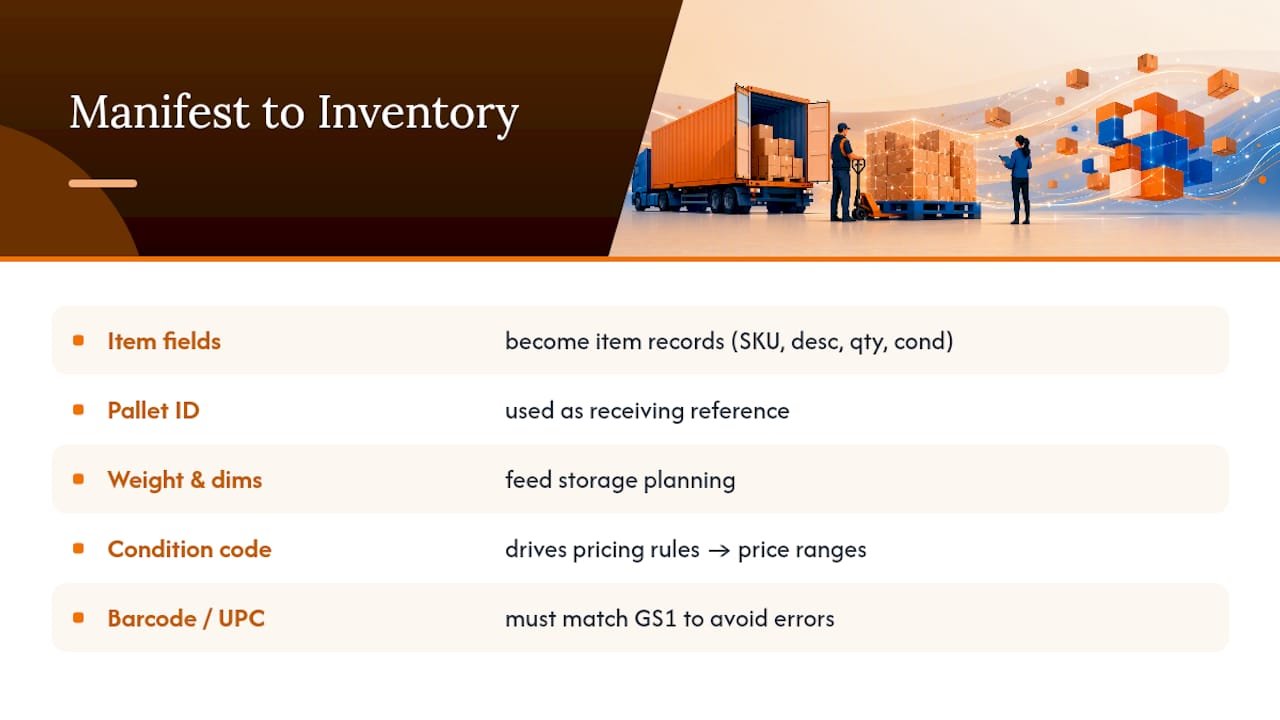
The transfer matters because manifest fields map almost directly onto standard inventory records. SKU, description, quantity, and condition become your item record; pallet ID becomes a receiving reference; weight and dimensions feed into storage planning. If you’re running a warehouse management system, most platforms accept CSV imports, which means a well-formatted manifest can populate your inventory database in minutes instead of hours of manual entry.
The condition code deserves special handling once it’s in your system. Rather than treating “like new” and “customer return” as generic tags, build them into your pricing rules so your system automatically suggests a listing price range based on condition and category. That turns a static manifest into a living pricing tool instead of a one-time reference document.
Barcode accuracy carries through the whole chain. If a manifest’s UPC doesn’t match GS1 standard formatting, your inventory system may fail to recognize the item during receiving, which creates phantom inventory or duplicate listings. Catching that mismatch at the manifest stage, before it enters your system, saves reconciliation work later.
Keeping Pallet Manifests Accurate as Inventory Moves
Manifests go stale the moment a pallet gets opened. Items shift, get damaged in transit, or turn out to be missing entirely, so treating the original manifest as a permanent record is a mistake most new resellers make once and then correct.
Update your working copy of the manifest as soon as you receive and inspect a pallet, not after you’ve already started listing items. Note any discrepancy between what the manifest claims and what you physically count, including condition mismatches where an item labeled “like new” arrives with visible damage.
Version control matters more than most sellers expect. Keep the original seller manifest as your source document, then maintain a separate “as received” version reflecting your own inspection. That separation protects you if you need to dispute a discrepancy with the seller, since you can point to exactly what changed and when.
Consistency in labeling saves time across multiple pallets. If you’re buying regularly from the same category, standardize your own condition-code shorthand and recovery-rate assumptions so every manifest you process gets evaluated the same way, rather than reinventing your valuation approach pallet by pallet.
Auditing a Manifest and Resolving Discrepancies With the Seller
Auditing starts the moment the pallet arrives, before you list a single item. Count physical units against manifest quantities line by line, and separate discrepancies into three buckets: missing items, condition mismatches, and undisclosed damage.
Photograph anything that doesn’t match the manifest before you move or repackage it. A timestamped photo showing a damaged item still shrink-wrapped on the original pallet is far stronger evidence than a written complaint sent days later.
Check the seller’s returns and refund terms before you buy, not after a dispute starts. Reputable liquidation sellers publish clear windows for reporting manifest discrepancies, and knowing that window in advance keeps you from missing a claim deadline because you were busy processing inventory.
Track discrepancy rates by seller over time. If one source consistently ships pallets that undercount items or misstate condition, that’s a pattern worth pricing into your future offers, or avoiding that seller altogether. A single bad manifest is a cost of doing business; a repeated pattern is a signal to buy elsewhere.
Publisher Perspective: How Mega Pallets Liquidation Approaches Manifests
Buyers evaluating manifests need more than theory. They need to see how a real seller structures one.
Manifested pallets across various categories, from electronics to general merchandise, list condition indicators directly on the product page, alongside manifest details buyers can review before checkout. If a listing’s condition terminology is unclear, buyers can request clarifying photos before purchase, and can review return terms ahead of time rather than after a dispute starts.
— Nene
Where to View Manifested Pallets and Buy With Confidence
You’ve now got the framework: read the columns, check the condition legend, run the numbers, and set your ceiling price before you click buy. Certain sellers provide that manifest data upfront on the product page itself, so buyers can price against real SKU-level detail instead of guessing at what’s inside a sealed pallet.

Start with a live example. The Bed, Bath & Beyond Manifested Pallet – JHR4 and the standard Bed, Bath & Beyond Manifested Pallet both list itemized contents you can review before committing. If electronics fit your resale channel better, the AMZ Premium HPC Pallet shows the same manifest structure applied to a different category.
The buying path is simple: inspect the manifest, compute your max buy price using the workflow above, request photos if anything’s unclear, then add the pallet to your cart and choose shipping or pickup. Check the condition legend and estimated freight cost one more time before you check out. Browse the full liquidation pallet inventory to compare categories side by side and find the load that fits your resale channel.
Sources
- What Is a Liquidation Pallet Manifest? – Liquidation Pallets | Great Deals on Wholesale Pallets
- Eurosaleonline
- Trucking manifest template fields and requirements
FAQ
What Is a Pallet Manifest?
A pallet manifest is an itemized list tied to a specific pallet showing product descriptions, quantities, and often condition and estimated retail value, letting buyers judge contents before purchase.
What Does a Manifest Example Look Like?
A typical manifest example lists columns for SKU or UPC, description, quantity, unit of measure, condition code, and MSRP, with each row representing one product line on the pallet.
What Is an Unmanifested Pallet?
An unmanifested (blind) pallet ships with no itemized content list, so buyers price it lower to offset the added risk of not knowing exactly what’s inside.
What Are Some Unique Pallet Project Ideas?
Beyond straight resale, buyers use manifested pallets for bundle-building (pairing complementary items into gift sets), flea market lot sales, and sourcing parts or components from salvage-condition electronics lines.
Why Shouldn’t I Trust the MSRP Total on a Manifest?
MSRP reflects original retail pricing, not what the item will actually sell for in a resale channel, so sellers often use it to inflate a pallet’s perceived value rather than its real recovery potential.
Recommended
- Wholesale General Merchandise Pallets: Unbeatable Resale Value & Variety
- Grocery Pallets Wholesale Mixed : Unbeatable Bulk Food & Household Essentials
- 5 Pallet Resale Mistakes New Resellers Make & How to Avoid Them
- Shop Liquidation Pallets | 100+ Unbeatable Wholesale Pallet Deals | Liquidation Pallets For Sale